How to Beat Writer’s Block

Ever find yourself in a creative log jam? Try the following technique excerpted from the StoryWeaver story development software to help regain your inspiration:

1. Inspiration

Inspiration can come from many sources: a conversation overheard at a coffee shop, a newspaper article, or a personal experience to name a few. And, inspiration can also take many forms: a snippet of dialogue, a bit of action, a clever concept, and so on. One thing most inspiration has in common is that it is not a story, just the beginnings of a story. To develop a complete story, you’ll need a cast of characters, a detailed plot, a thematic argument, and the trappings of genre.

But how do you come up with the extra pieces you need?

In the questions that follow StoryWeaver will help inspire you, even if you can’t come up with an idea to save your life! If you don’t yet know what your story is going to be about, StoryWeaver will help you find out. And if you do have something already worked out, these questions will help you fill in the details.

2. What do you have to start with?

If you already have an idea of what your story is about, describe it briefly in your word processor. Don’t go into great detail at this time, just the key concepts, people, and events. If you don’t yet have a story idea, advance to the next question and StoryWeaver will help you come up with one.

3. Nonsense!

If you are stuck for ideas, it’s probably because you are trying to force yourself to be creative – a situation often referred to as “Writer’s Block.” Fortunately, there is a trick you can use to break through Writer’s Block and get your creativity flowing again! First, write down three nonsense words. Don’t stop to think it over, just jot down the first words that come to mind, as in a word-association test.

4. Meaning

Now, imagine that all of your nonsense words are part of the same phrase. How many different stories can you think of that incorporate that phrase? Briefly describe each story idea.

Background:

We all try to find meaning in what we see. That is why we identify pictures in inkblots, see faces in wood grain, and animal shapes in clouds. So even when no meaning is intended, our minds can’t help but impose it. By picking words at random, stringing them together and then looking for meaning, we move our minds out of creative block and into analysis mode. In other words, we temporarily shift from creation to interpretation. In so doing, our subconscious automatically creates alternative meanings that fit what we see. Use the Reference button to look at the meanings you just described and what you originally said your story was about (if you answered that question).

5. Combining Meanings

Now, try to incorporate into a single story idea as much as you find interesting from all the different story ideas and your original idea combined.

Background:

Of course, some of the meanings you came up with may be completely ridiculous and not useful at all. And, there may be no way to work them all in, yet several ways to include some of your inspirations. If you have several ways to combine these various ideas, list them all. But if you can’t think of any way to bring these ideas together, don’t worry!

The purpose of this exercise is break free of Writer’s Block, and the very process of shifting out of forced creative mode and into analysis mode usually does the trick. So, even if none of the nonsense interpretations are usable in and of themselves, when you return to your original ideas, you’ll probably find whole new inspirations easily come to mind. Whenever you find yourself stuck, return to this method and (more times than not) the ideas will flow again.

Change and Steadfast Characters in the Real World

In Dramatica theory, characters can grow by changing or by growing in their resolve to remain steadfast. But how does that translate to the real world? Here are some examples:

Change:

At the end of the story, the Main Character’s basic way of seeing things has changed from what it was at the beginning of the story. For example, a stubborn bounty hunter, who sees every criminal as “guilty,” changes to realize this isn’t true for every criminal and decides that he is chasing an innocent man; a woman who has always put her job before her family changes, and puts her family first by adapting her schedule so she can spend more time with her husband, even though it will mean missing a promotion; etc.

Steadfast:

At the end of the story, the Main Character’s basic way of seeing things has remained the same as it was at the beginning of the story. For example, a man wrongly accused of murdering his wife remains steadfast in his pursuit of the real killer believing this will eventually solve his problems; Despite all attempts to convert her, a woman remains true to her faith in her religion believing her God will protect her; etc.

From the Dramatica Pro Software

Avoiding the Genre Trap

A common misconception sees genre as a fixed list of dramatic requirements or a rigid structural template from which there can be no deviation. Writers laboring under these restrictions often find themselves boxed-in creatively. They become snared in the Genre Trap, cranking out stories that are indistinguishable from a whole crop of their contemporaries

In fact, genre should be a fluid and organic entity that grows from each story individually. Such stories are surprising, notable, memorable, and involving. In this article, you’ll learn a new flexible technique for creating stories that are unique within their genres.

How We Fall Into the Genre Trap

The first step in escaping from the Genre Trap is to understand how we fall into it in the first place. Consider how wrapped up you become in the details of your story. You slave over every plot point, struggle to empathize with every one of your characters, and perhaps even grieve over the effort to instill a passionate theme.

The problem is, you become so buried in the elements of your story that you lose sight of what it feels like as a whole. So while every piece may work individually, the overall impact may be fragmented, incomplete, or inconsistent. To avoid this, we fall back on “proven” structures of successful stories in a similar genre. We cut out parts of our story that don’t fit that template, and add new sections to fill the gaps. We snip and hammer until our story follows along the dotted lines.

And lo and behold, we have fallen into the genre trap – taking our original new idea and making it just like somebody else’s old idea. Sure, the trappings are different. Our characters have different names. The big battle between good and evil takes place in a roller rink instead of a submarine. But underneath it all, the mood, timber, and feel of our story is just like the hundred others stamped out in the same genre mold.

A New Definition of Genre

Rather than thinking of your story as a structure, a template, or a genre, stand back a bit and look at your story as it appears to your reader or audience. To them, every story has a personality of its own, almost as if it were a human being. From this perspective, stories fall into personality types, just like real people.

When you meet someone for the first time, you might initially classify them as a Nerd, a Bully, a Wisecracker, a Philanthropist, or a Thinker.

These, of course, are just first impressions, and if you get the chance to spend some time with each person, you begin to discover a number of traits and quirks that set them apart from any other individual in that personality type.

Similarly, when you encounter a story for the first time, you likely classify it as a Western, a Romance, a Space Opera, or a Buddy Picture. Essentially, you see the personality of the story as a Stereotype.

At first, stories are easy to classify because you know nothing about them but the basic broad strokes. But as a story unfolds, it reveals its own unique qualities that transform it from another faceless tale in the crowd to a one-of-a-kind experience with its own identity.

At least, that is what it ought to do. But if you have fallen into the Genre Trap, you actually edit out all the elements that make your story different and add others that make it the same. All in the name of the Almighty Genre Templates.

How to Avoid the Genre Trap

Avoiding the Genre Trap is not only easy, but creatively inspiring as well! The process can begin at the very start of your story’s development (though you can apply this technique for re-writes as well).

Step One – Choosing Genres:

Make a list of all the Stereotypical Genres that have elements you might want to include in the story you are currently developing. For example, you might want to consider aspects of a Western, a Space Opera, a Romance, and a Horror Story.

Step Two – Listing Genre Elements:

List all the elements of each of these genres that intrigue you in general. For example:

Western – Brawl in the Saloon, Showdown Gunfight, Chase on Horseback, Lost Gold Mine, Desert, Indians.

Space Opera – Time Warp, Laser Battle, Exploding Planet, Alien Race, Spaceship Battle, Ancient Ruins.

Romance – Boy Meets Girl, Boy Loses Girl, Boy Gets Girl, Misunderstanding alienates Boy and Girl, Rival for Girl throws out Misinformation, Last Minute Reveal of the Truth leading to Joyful Reunion.

Horror Story – Series of Grizzly and Inventive Murders, The Evil Gradually Closes in on the Heroes, Scary Isolated Location, Massive Rainstorm with Lightning and Thunder.

(Note that some genre elements are about setting, some about action, and some about character relationships. That’s why it is so hard to say what genre is. And it is also why looking at genre, as a story’s Personality Type is so useful.

Step Three – Selecting Genre Elements:

From the lists of elements you have created, pick and choose elements from each of the genres that you might like to actually include in your story.

For example, from Western you might want Lost Gold Mine, Desert, and Indians. From Space Opera you might choose Spaceship Battle, Exploding Planet and Alien Race. Romance would offer up all the elements you had listed: Boy Meets Girl, Boy Loses Girl, Boy Gets Girl, Misunderstanding alienates Boy and Girl, Rival for Girl throws our Misinformation, Last Minute Reveal of the Truth leading to Joyful Reunion. And finally, from Horror Story you might select Scary Isolated Location, Massive Rainstorm with Lightning and Thunder.

Step Four – Cross Pollinating Genres:

From this Master List of Genre Elements that you might like to include in your story, see if any of the elements from one genre have a tie-in with those from another genre.

For example, Indians from the Western and Alien Race from the Space Opera could become a race of aliens on a planet that share many of the qualities of the American Indian. And, the relationship between the boy and the girl easily becomes a Romeo and Juliet saga of a human boy colonizing the planet who falls in love with an alien girl.

Step Five – Peppering Your Story with Genre Elements:

Once you’ve chosen your elements and cross-pollinated others, you need to determine where in your story to place them. If you are stuck in a Genre Trap, there is a tendency to try and get all the genre elements working right up front so that the genre is clear to the reader/audience.

This is like trying to know everything there is to discover about a person as soon as you meet him or her. It is more like a resume than an introduction. The effect is to overload the front end of the story with more information than can be assimilated, and have nowhere left to go when the reader/audience wants to get to know the story’s personality better as the story unfolds.

So, make a timeline of the key story points in your plot. Add in any principal character moments of growth, discovery, or conflict. Now, into that timeline pepper the genre elements you have developed for your story.

For example, you might decide to end with a massive spaceship battle, or you could choose to open with one. The information about the Alien Race being like the America Indians might be right up front in the Teaser, or you could choose to reveal it in the middle of the second act as a pivotal turning point in the story.

Because genre elements are often atmospheric in nature, they can frequently be placed just about anywhere without greatly affecting the essential flow of the plot or the pace of character growth.

As you look at your timeline, you can see and control the reader’s first impressions of the story genre. And you can anticipate the ongoing mood changes in your story’s feel as additional elements in its personality are revealed, scene-by-scene or chapter-by-chapter.

What about Re-writes?

Not everyone wants to start a story with genre development. In fact, you might want to go through an entire draft and then determine what genre elements you’d like to add to what you already have.

The process is the same. Just list the genres that have elements you might wish to include. List the elements in each that intrigue you. Select the ones that would fit nicely into your story. Cross-Pollinate where you can. Pepper them into your existing timeline to fill gaps where the story bogs down and to reveal your story as a unique personality.

Summing Up the Sum of the Parts

Genre is part setting, part action, part character, and part story-telling style. Trying to follow a fixed template turns your story into just another clone. But by recognizing that genre is really a story’s personality type, you can make it as individual as you like. And by peppering your elements throughout your story’s timeline, you will create first impressions that will capture your reader or audience and then hold their interest as your story’s one-of-a-kind personality reveals itself.

Word Salad: Slicing and Dicing Story Structure

A writer recently asked:

I’ve read what you wrote about slicing and dicing the Dramatica chart on your web site and in Dramticapedia. It’s very interesting.

Two questions if I may:

* Limiting depth: “When you limit depth, you simple don’t explore one or more aspects of a story: Character, Plot, Theme, or Genre.”

Q: If you don’t explore Plot, you don’t have the signposts. So how does your story move along?

* Limiting breadth: “Two throughlines provide a conflict. But three seems to be one conflict and another superfluous throughline that bounces off nothing.”

Q: In Dramatica I thought 3 throughlines — MC, OC and SS — were necessary to explore the conflict between the main and obstacle characters. I guess I didn’t get that right?

Examples of those two approaches would be great of course!

My reply:

In answer to your question on “Limiting Depth”:

Q: If you don’t explore Plot, you don’t have the signposts. So how does your story move along?

Two points: First, stories may be all about character growth. For example, a character may simply explore their feelings about life, people they know or thematic values and topics. There need be no events, happenings, or progress to illustrate how that character is growing, how the thematic message is evolving or how the genre is adding depth and richness as the story progresses. For example, look to the classic play, Waiting for Godot by Samuel Beckett. In this play there is no plot to speak of, yet the two principal characters progress along lines of growth or at least exploration of their feelings, make thematic points and establish a genre.

Other stories in a similar stream of consciousness style (as also used by Virginia Woolf) while including events, do not concern themselves with creating a full-story meaning for the happenings, but simply a series of random occurrences which transpire. This illustrates a second approach to writing without plot, per se: to have things take place, but not to use them to convey meaning. In such a story, one is not exploring plot – in fact, one has not created a true plot, just sequence of events. These serve to give the characters something to do other than talk, yet are intentionally presented so that the reader or audience understands no message is contained in the jumble of activities. Virginia Woolf’s Orlando is an excellent example of this style.

Also keep in mind that there is a big difference between a tale and a story. A tale is a simple linear progression of characters, plot, theme, and genre. A story uses each scene as a building block in a larger mosaic that creates a “big picture” message. So, even if the events make sense as a logical series of happenings and function well as a tale, this does not mean the events contribute as part of a story’s plot in terms of an overall message. Orlando, at times, does indicate a reason-based progression but its impact has little to do with the growth of the main character or the development of the theme. At most, it adds some elements to the genre, but in the storytelling sense, not structurally.

In answer to your second question on limiting breadth:

Q: In Dramatica I thought 3 throughlines — MC, OC and SS — were necessary to explore the conflict between the main and obstacle characters. I guess I didn’t get that right?

Actually, all three throughlines are indeed necessary to exploring that conflict, but what if you don’t explore the conflict? Suppose you have a one-person show where the Main Character presents just his own reasons for what he did and his own value standards that he questioned in the process. You might explore all four levels of the Main Character throughline without ever mentioning the influence of an Obstacle Character, any Subjective Story conflict between the two, or even an Objective Story involving anyone else.

Or suppose you have just a Obstacle Character explaining, “I had to change his mind… I knew he was on the wrong track. At first I appealed to his reason while sharing the bus together one day on the way to work. Failing any impact from that, I tried another tack, the passionate approach, and tried to invoke some sort of emotional response. And still, nothing.” This could be a wonderful opening to a story that only explored the Obstacle Character throughline without ever describing the Main Character’s point of view or the specific arguments between them.

Now here’s an advanced concept that applies to both Slicing and Dicing:

Just because characters are almost always built from elements doesn’t mean you can’t build them from the other levels of the Dramatica Table of Story Elements. At the level of the Table above the elements are the Variations. Though these are usually employed as the building blocks of the theme, they might equally be represented as characters instead. So, for example, you might have a character representing “hope” or “rationalization” or “wisdom”.

In a Sliced story with only the variation level, you might choose to illustrate the Variations as characters and simply have each stating his or her (or its) belief in the preeminence of the quality it represents. Or, in a Diced story with only one throughline, you could mix it up so that the Variations are represented by characters, the Elements by the plot, the top “Class” level would indicate the thematic issue (such as Physics, external processes, seen as the focus of the theme) and the Types become the Genre components.

Such stories are occasionally told, though they are not popular as they require an awful lot of work by the reader or audience to shift their minds around to see things in that way. It is not impossible, just difficult, and puts a burden of effort on the recipient of the story that normally resides with the author.

Finally, consider that many of the stories told are not really stories but tales. As referenced above, a tale is nothing more than an unbroken chain of events and/or experiences that make logical and/or emotional sense. Tales are free of the restrictions and requirements that bind stories, and so they can be far more free form, make incomplete arguments just for effect, and can include any number of random happenings either for intended impact on the readers/audience or for simple convenience to the author, or for stream-of-consciousness expression as part of the creative effort.

In such a case, any fragment or level of a story structure, sliced or diced, will easily mix into the overall word salad.

Melanie

Finding & Fixing Holes in Your Story Structure

A writer recently asked:

Hi, Melanie. I found your website while researching for my feature film screenplay. I have been rewriting this version of the script since October 2010 and writing the entire script for over ten years.

I am feeling rather lost now in this draft as my ending does not line up with how I have rewritten it – I am beyond 120 pages and it would take several more to finish telling my story at this time.

Would you please let me know what I need to discover the holes and make sure I do not have any structural problems (which I believe I have right now)?

I deeply want to master this story and move into production, but I just keep feeling like I am not there yet.

What is the right first step to your process? Do you recommend I start with Dramatica Pro and Storyweaver? As mentioned, I have written this story extensively and know who my characters are and where they are going, I just need some help them getting there.

My reply:

First of all, 120 pages isn’t a rule, just a guideline. So if you are just several more pages, say under 130, you should be fine. (That’s why some movies are 95 minutes and others 135).

As for holes and inconsistencies, your best bet is Dramatica Pro. You answer questions about your story and it cross-references the dramatic impact of your answers to determine what other dramatics need to be included. You can then compare that output to your actual story to see where you may have drifted structurally or where you may have left something out.

StoryWeaver is a more creativity based tool. It helps with inspiration, coming up with your story’s world, who’s in it, what happens to them, and what it all means. It doesn’t sound like you need that kind of help. StoryWeaver is a lot more intuitive and Muse oriented, rather than Dramatica which is logic and analysis focused.

You can download a trial version of both of these at our web site at storymind.com

Melanie

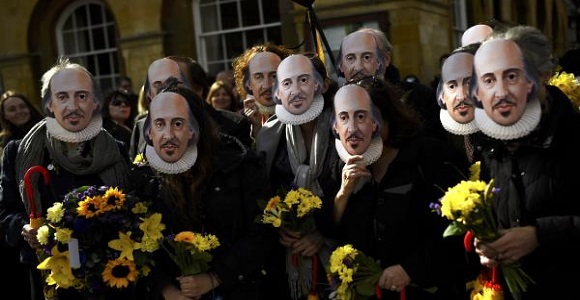
Don’t Try To Be Shakespeare – He Didn’t!

Shakespeare just wrote as himself, and you should too. While trying to emulate another famous writer can be useful as an exercise (just as an artist might copy the Mona Lisa as a “study”), that approach is never useful in creating or advancing your own art.

Sure, read what other write, dissect their work, and practice their techniques – even in your own creations, but ONLY if those techniques also fit your own personality and style.   The best way to achieve Writer’s Block is to try and write like someone else.  When you do, you are hobbling your Muse; locking her in irons.  You are trying to play a role for which you are unsuited.

Of course we all want to be beloved successful writers, but we are not all going to be.  You are only as good as you own talent – GET OVER IT!

Why are you writing in the first place?  To make a buck?  To make a name for yourself?  Or perhaps, just perhaps (Lord help us) because you actually like writing?  Or maybe, just maybe, because you want to like writing, but don’t, try as you may?

Fact is, while money and fame are good motivators for any career, be it singing, dancing, playing a sport or writing, if they are the Prime Motivators, you won’t have a very good time doing it, whatever “it” is.

The Wise Man famously said, “Work at what you love and you’ll never work a day in your life.”  The important aspect here is that he didn’t expect to become a famous wise man when he said it.  It just occurred to him as part of his personally satisfying manner of thinking.  Just as it occurs to me to say, “Don’t blame the weather – its’ only humid.”

Now that clever little phrase is never going to make me rich OR famous.  But I did have a really enjoyable time telling it to you.  And that, dear readers, is the very essence of the writing life to which we should all aspire.

Unless you truly enjoy laboring over a single book for your entire life, word by word, with endless rewrites and improvements, then just write it out as you feel it.  Plot doesn’t make sense?  Come back to it later when you know your story better.  Characters dull and derivative?  You’re not going to fix them by micromanaging them.

Give it up and get on with it.  Write endlessly.  Write until your fingers fall off.  Keep an archive somewhere to put all the stuff the world should never see and then post the bulk of the rest on your blog.  (You DO have a blog, don’t you?  All real writers have a blog…..)  And for those gems – the occasional piece that just zings and sings and hits the mark – well those you send off to a publisher, magazine or agent.

If you’re looking for gold, you won’t find as much by sifting the same sand through a finer and finer mesh as you will by marching from one dig to the next in search of nuggets.  So be prolific, knock the blocks out from under your tires, throw open the stop-cocks and let loose the dogs of words.

Descrepencies in Dramatica Terminology?

A Writer recently asked:

Dear Melanie,

I think, if I understand this correctly, that there is an incongruence between the Dramatica software terminology and the book – in that the software calls it the “Main vs. Impact Storyline” whereas the book calls it the “Subjective Storyline”. Am I correct in assuming that both mean the same thing?

Best wishes,

Jens

My reply:

Hi, Jens.

There are a few terms over which I and the other co-creator of Dramatica, Chris Huntley, don’t completely agree.

So, when we teach separate classes, we usually go with what we each think is best. When we teach together, we go with what is in the software because that is how most people come to Dramatica.

Example: “Main vs. Impact Storyline” is the same as the “Subjective Story”. Just different names.

Additionally I don’t use the term Impact Character at all, because this character does not necessarily have any physical impact on anything. In fact, even the old term “Obstacle Character” also seemed to me to give a wrong impression. Chris changed it from Obstacle to Impact to improve it, but in my writings on Dramatica I use the term “Influence Character” because that (to me) more clearly indicates its role as the most influential character over the Main Character in regard to his or her central, personal drive or issue.

For example, the lost diary of a long-missing poet might make that poet the Influence Character for a young Main Character who is a young aspiring poet himself. The Main Character learns from the writings how to avoid self-destruction, to continue the example, and does not commit suicide like his idol does at the end of the diary. There is no “impact” or “obstacle” in this storyline, but a lot of gentle and gradual influence.

But, you did ask the right question in the first place. What is really important is the concept, not the term, and on that Chris and I both agree.

Melanie

StoryWeaver vs. Dramatica

Writers often ask what the difference is between StoryWeaver and Dramatica Pro (or it’s little brother, Writer’s DreamKit).

Here’s the answer in a nut shell:

StoryWeaver and Dramatica (or Writer’s DreamKit) are like hand and glove, or two sides of the same coin. Every story has a personality and a psychology. The personality is developed in the storytelling, the psychology is built by the structure. StoryWeaver deals with the perosnality; Dramatica (and DreamKit) deal with the structure.

StoryWeaver is an inspiration and development tool for figuring out your story’s world, who’s in it, what happens to them, and what it all means. DreamKit helps you find and refine the underlying dramatic framework for your story to ensure there are no holes or inconsistencies.

Each one offers a step-by-step approach, and many authors use both for the two different aspects of story creation. Which one is used first, depends on the author. A structural writer will want to use Dramatica first to build the dramatic framework for the story, then use StoryWeaver to turn it into real people, places and events. An intuitive writer will want to use StoryWeaver first to help them find their story, then use Dramatica to find and refine the underlying structure that has evolved in their story along the way.

As always, you can learn more about both StoryWeaver and Dramatica at our sales-oriented web site at Storymind.com

A Poem Based on Dramatica

Some time ago, I decided to write a poem based on sound Dramatica Theory of Narrative concepts.  Specifically, I wanted to cover all four throughlines (I, You, We, and They) and have each follow a quad (family of four) of plot points as an illustration of signpost/journey four act/three act structure seen from all four points of view.

Here’s the result:

“Lulladie”

by Melanie Anne Phillips

My emotions are dead
and lack any resistance
to the onslaught of logic’s
relentless persistence.

I’m malleable, moveable,
flexible, still.
I succumb with aplomb,
as I alter my will

to conform to the pressures
that weigh on my soul
without motive, or method,
opinion, or goal.

They reach for the stars,
as they stand on our hearts,
and they sell us off piecemeal,
parcels and parts.

They slice us to mincemeat
and padlock the door,
while our blood runs quite freely
through holes in the floor.

But nothing is wasted,
tho’ everything’s lost.
So our blood is recycled
to offset the cost.

We huddle in darkness
yet shy from the fire
to howl at the moon
with the rest of the choir.

And when the glow wanes,
we stoke it with dreams
in hopes that the crackle
will drown out our screams.

You sleep in your bed
and you doze in your chair.
Your cushions are comfy
and so is your air.

But your heartache grows heavy,
as well as your head,
‘til you nod away, nod away,
nod away, dead.

Copyright Melanie Anne Phillips

Learn more about Dramatica