The Four Throughlines (Part 1)

The structure of a story is the psychology of a single mind made tangible. For the story to be sound and ring true, the psychology must be complete and valid.

But to make a complete argument, it is not enough to simply reproduce the Story Mind structure. We must go beyond that and move into a larger realm that involves the audience.

In a nutshell, the audience will not be satisfied until they see the Story Mind presented to them from four different points of view – the Objective Story, the Main Character, the Obstacle (or Influence) character, and the Subjective Story.

Simply put, imagine the goings on in a story as a battle. We can watch that battle from up on a hill overlooking the field, as a General might. This is what we call the Objective view of the story, since it is seeing the story from the outside in.

Though from this perspective we care about what happens, it is not as if it is happening to us. Rather, we are simply watching it happen to others. Because we see the big picture, we can tell if a soldier is headed into an ambush, or how he might best achieve his goals. We can evaluate decisions made on the field as being good or bad in the grand scheme of things.

The Objective view is the same perspective we have in real life when we see others trying to deal with their problems. It is easy for us to think we see the best course, not being involved ourselves, and we often offer advice and comments like, “Why don’t you just…” or “How could you possibly have….”

Of course, this ignores how that person might feel, and dismisses any attachments or emotional needs they may have. Because we have no vested interest in the outcome, we can consider the situation dispassionately. After all, we don’t have to wake up in the morning having to deal with the consequences of their actions.

But if we zoom down onto the field and stand in the boots of one of the soldiers, we get a completely different point of view – the Main Character perspective. From here we experience the most passionate appreciation of the battle, rocked by the concussion of dramatic explosions all around us, stumbling across the field without that objective overview, just trying to do our job and survive the clash.

The Main Character view represents our own sense of self – the Story Mind’s self awareness. It is the view from the inside looking out. Though we can clearly see the situation surrounding others, that is a perspective we cannot get of ourselves. Rather, we must try to deduce the “big picture” based on the little personal glimpses of it we get while we grapple with our problems.

For an audience to feel that all the angles of the story’s problems have been explored, both of these real life points of view must be included in the structure. And yet, even they are not sufficient: there are two more perspectives required as well.
The Scope of Dramatica

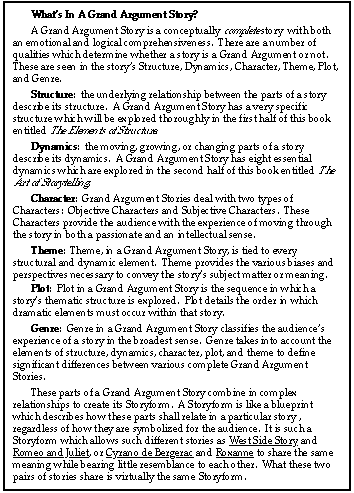
Even with all the various forms of communication, Dramatica ins’t limited by addressing only the Grand Argument Story. The Grand Argument model described by Dramatica functions to present all the ways a mind can look at an issue. As a result, all other forms of communication will be drawing on a portion of those same dramatic elements, just in smaller combinations. In a previous example, we indicated that the less we said, the more the audience could use its imagination. But that pertains primarily to storytelling.  When it comes to story structure, the more complete the story’s argument, the more powerful the structure.  A Grand Argument Story says it all. Every point is made, even if hidden obscurely in the heart of entertainment. Other forms of communication use “slices” of the model, chunks, or levels. Even if an author is unaware of this, the fact that human minds share common essential concepts means that the author will be using concepts and patterns found in the Dramatica model.

The Story Mind

What is the Story Mind? Dramatica says that “Every complete story is an analogy to a single mind trying to deal with an inequity.” Now that’s very scientific, but what does it really mean? It means that characters, theme, plot and genre are not just people with value standards doing things in an overall setting – rather, character, theme, plot and genre are different families of thought that go on in our own minds, mad tangible, incarnate as character, thematic arguments and plot points.

So a story is as if an author took the mechanism of our minds, made it tangible and put it out there for us to look at so we could examine the problem solving process. Rather than having to be involved in it subjectively, we are told by the author that he or she has the benefit of insight or experience, and that even though it may feel one way to us on the inside, there is a more objective understanding of how we should proceed.

In fact, the Main Character represents the reader/audience position in the story. It represents our own position in our own heads. We know who we are at any given time. In regard to any given issue, we know where we stand.

In essence then, the Story Mind concepts says, “Think of a story as if it were a person.” There’s only one Main Character in a story because there’s only one “I” in our own minds. Further, we all have the same emotional and logical considerations, and each of these must appear as characters in a story for it to feel complete as well. If any parts are missing, the story’s argument will feel incomplete.

Dramatica also says that this Story Mind system came into being as a natural by-product of the process of communication. If you want to state that the approach you are promoting in your story is either the best or worst of all that might be tried, that you have to actually show all the other approaches that might reasonably be taken and illustrate why they aren’t as powerful as yours.

When you create a story argument that has no holes, then you have included all the ways a human mind might consider to solve a problem. In effect, you have created a model of the mind’s problem solving process – a Story Mind.

No one set out to build this model directly. But through centuries of trial and error in storytelling, conventions were developed that worked because they built an analogy to the psychology of the mind.

Every once in a while, stand back from your story. It is so easy for an author to get so lost in the details of making all the parts work that he or she loses sight of the big picture – the overall impact of the story as a whole.

Take time to examine whether your story has a sound psychology that makes it feel like a functional person, that there are no wanky inconsistencies, and that the personality of the story itself is both human and interesting as well.

The Free Form Author

While some authors write specifically to make an argument to an audience, many others write because they want to follow their personal Muses. Sometimes writing is a catharsis, or an exploration of self. Sometimes authoring is a sharing of experiences, fragmented images, or just of a point of view. Sometimes authoring is marking a path for an audience to follow, or perhaps just presenting emotional resources the audience can construct into its own vision. Interactive communications question the validity of a linear story itself, and justifiably so. There are many ways to communicate, and each has just as much value as the next depending upon how one wishes to affect one’s audience.

Writing Remakes and Adaptations

What happens if you mess up and just alter part of a structure without considering the structure-wide impact that change may have? Here’s an example….

Consider the Bill Murray film, “Scrooged:” (a remake of Dickens’ “A Christmas Carol”) as opposed to “Scrooge” (the 1951 version of the story starring Alistair Simm).

In the Simm version, Scrooge goes about business in the usual English fashion, but lacks generosity. That is illustrated by his refusal to donate to charity, his lack of consideration for Bob Cratchett’s family’s plight, and statements about the poor such as, “If they would rather die, then they should do so and decrease the surplus population.”

Though some of this continues to exist in the Murray vehicle, the writers clearly wanted to me his character even more of a villain. So, they spent far more time focusing on how mean Murray’s character is, rather than staying centered on his lack of generosity.

In the Simm movie, Scrooge, the ghost bombard him with visions of those he hurt because he might have helped yet did not. Even in the first act, Marley’s ghost laments that he and his ilk are doomed to wander the earth, witnessing those who need help but being unable to intercede.

In the Murray picture, the ghosts make more or less the same argument – there are those who are suffering because you will not help. Yet, that isn’t his problem in this version. His problem is that he is mean-spirited.

In the Simm story (as in Dickens’ original), the Ghost of Christmas Present confronts him with two waifs named Ignorance (lack of education) and Want (lack of what is needed). This drives how the point that it is a lack of action from which Scrooge suffers.

The same arguments are made to Bill Murray’s character. But when he finally changes, it seems a bit hollow. It feels somewhat unmotivated and trite.

Don’t get me wrong, I love the film. But wouldn’t it have been far more satisfying at an emotional level if the argument had matched the problem that needed to be resolved.

If the writers of “Scrooged” had wanted to update the story by making the lead character more proactively villainous, then they should have changed the arguments made by the ghosts as well. Instead of showing Ignorance and Want, they might have shown Defeat and Suffering. These would be the children of the Murray-Scrooge character’s actions – victims of his mean-spiritedness, and a truth with which he could not quibble.

As you can see, structure and storytelling are intimately acquainted, yet are two different creatures. Storytelling can be altered at (as George W. Bush said) “The whim of a hat.” But structure cannot be made mincemeat, willy nilly. No sir! Structure must remain balanced, in symmetry, and if one aspect is changed, then care must be given to ensure that all other affected parts of the structure (directly or indirectly) must be appropriately adjusted as well.

Grand Argument Stories

Grand Argument Stories

The question arises: Is telling a story better than telling a non-story? No. Stories are not “better” than any other form of communication — just different. To see this difference we need to define “story” so we can tell what a story is and what it is not. Herein lies a political problem. No matter how one defines “story,” there will be an author someplace who finds his favorite work has been defined out, and feels it is somehow diminished by not being classified as a story. Rather than risk the ire of countless creative authors, we have limited our definition to a very special kind of story: the Grand Argument Story.

As its name indicates, a Grand Argument Story presents an argument. To be Grand, the argument must be a complete one, covering all the ways the human mind might consider a problem and showing that only one approach is appropriate to solving it. Obviously, this limits out a lot of creative, artistic, important works — but not out of being stories, just out of being Grand Argument
Stories. So, is a Grand Argument Story better than any other kind? No. It is just a specific kind.

Unfolding Your Thematic Topic

The thematic topic is the subject matter of your story, such as “death,” or “man’s inhumanity to man.” No matter what topic you will be exploring, it will contain large issues, small issues, and everything in between.

In Act One, you need to introduce and establish your theme so that your readers or audience gets a sense of the kinds of issues you’ll be exploring. To do this, you have three different approaches available.

1. You could outline the scope of your subject matter with one or more large, definitive dramatic moments. Then, in acts two and three, you would gradually fill in smaller and smaller details, adding nuance and shading to the overall topic as the story progresses. This system is best when trying to apply topics that are often seen objectively or impersonally to everyday life.

2. Conversely, you could begin with the details in Act One, then move to larger concerns as the story progresses. This is a good way to elevate topics dealing with commonplace, mundane, or work-a-day issues to philosophical or global importance.

3. Finally, you could mix it up, presenting a blend of issues ranging from the large to the small in every act. This creates a feeling that the topic is an area to explore, rather than a statement to be understood.

Whichever approach you take, the pattern needs to be set up in Act One so your reader or audience can follow. So determine which approach you wish to take and then create specific examples that illustrate your topic, both in a large and small way.

Finally, pepper these examples into each act as the scope of your topic broadens, narrows, or contrasts the two extremes as it goes.