Archetypes in Wizard of Oz

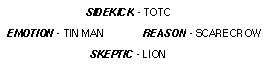
We can label Dorothy as the Protagonist in The Wizard of Oz with some confidence. Certainly the Scarecrow seems to be Reason since he is the planner of the group (“I’ll show you how to get apples!”), but he is not very calm or collected. In fact, he is quite the opposite. Similarly, the Tin Man looks like Emotion as he cries in the poppy field, yet he is anything but frenetic when he rusts himself from the tears.

Let’s file that away for later and press on. The Cowardly Lion fills the role of Skeptic and Toto performs as the Sidekick. Glinda is an unabashed Guardian and the Wicked Witch of the West balances her as the Contagonist. But just a moment here… Doesn’t the Wicked Witch act more like an Antagonist? Indeed she does, yet she seems to also fill the same role compared to Glinda as Darth Vader fills compared to Obi Wan. Assuming for a moment that the Wicked Witch IS the Antagonist, then who is the Contagonist?

There is only one major character yet unaccounted for — the Wizard himself.

The Wizard as Contagonist? Somehow it doesn’t sound quite right. At this point it becomes apparent that the characters in Oz are not all exactly Archetypal. Something is going on with the Scarecrow and Tin Man and the Witch and the Wizard that doesn’t quite fit. Exploring these shortcomings of the Archetypal Character model as applied to Oz will ultimately offer some insight into the essential character Elements.

For the time being, however, let’s pencil in the Witch as Antagonist and the Wizard as the Contagonist so we have a place to start. Here are the Eight Simple Characters of The Wizard of Oz in Quad format, ignoring any inconsistencies for the moment.

Drivers and Passengers in The Wizard of Oz

Driver Characters


Passenger Characters

From the Dramatica Theory Book

Your Story’s Title

What’s in a name? Having at least a working title will help you start your story, even if you ultimately change the title.

The title of your story may or may not have dramatic significance. In some cases, the meaning of the title may become apparent only during the course or even at the end of a story. There have even been stories in which the final understanding of the message is only achieved when the title becomes the last piece in the puzzle.

Examples:

Imagine all the other titles Star Wars might have had. In fact, it was originally titled Adventures of the Starkiller, Episode One of the Star Wars, then Adventures of Luke Starkiller, then The Journal Of The Whills. You can immediately feel the impact of a change in title on your impression of the story.

Consider the value of other example titles such as The Verdict; (which refers to the story’s climax), Alien; (refers to the subject matter), and The Silence of the Lambs ;(refers to the Main Character’s personal problems).

From Dramatica Pro Software

A Screenwriter’s Bag of Tricks

Most of our writing tips focus on the creation of a sound story, regardless of the medium in which you are working. But since the writing of screenplays has its own unique restrictions, requirements, and opportunities, we thought it might be useful to offer a Screenwriter’s Bag of Tricks.

Like any good grab bag, this collection of tips and techniques is in no particular order. Some are geared to the beginning screenwriter, others to the expert. But regardless of your experience level, you’re likely to find a few keepers.

Use index cards to work out the scenes in your script

Index cards (3×5 or 5×7 in size) are often used by screenwriters to plan out the sequence of events in their stories. Usually, a script has many different dramatic threads. The trick is how to weave them together over the timeline of the movie. For example, you might have several key challenges for your hero to overcome. You describe each of these on a different index card. You tack them up on the wall or lay them out on the table (or floor) and stand back and look at them. You see how the action seems to flow from one to another. Perhaps it seems that the ending is a bit anti-climactic, or that the build of dramatic tension isn’t right. So, you rearrange the order of the cards until you arrive at and order that feels the best.

Then, you may realize that you actually have a gap in the action that requires the creation of another challenge. So, looking at what comes before and what comes after, you determine the kind of action that is needed, and make a new card to fill the gap.

You might also realize that you have two challenges that are too much alike, or that would happen too close to each other, so you decide to lose one, or combine two into a single one that makes it all the stronger.

Then, you may know that you want a series of arguments between the hero and a love interest. In one creative session, you may work out how many arguments you want, and what each is about. You describe each of these arguments on a different index card.

As with the hero’s challenges, you tack up the cards and arrange them in the best possible order, filling gaps with new cards, and deleting or combining cards until the flow is right.

Since a movie generally focuses on one dramatic situation at a time, then intercuts among several different threads as necessary, your next job is to combine both the challenge thread and the argument thread into the overall timeline of your script.

You might decide to start with the first challenge card, then go to the first argument, and alternate. Or you might start with the first argument, have a second argument, and then two challenges in a row.

There are no “rules” as to how the two threads of cards should be shuffled together. It is purely a choice of how you wish to impact your audience.

You may even find that once you have blended the two threads into a single timeline, that combination highlights the need for an additional challenge or another argument, or perhaps the removal of one or the other. You might even be able to see the need for a whole new thread that is suggested once the first two threads are combined. So you create a third set of index cards, put them in order, and then weave them into the other two.

In this manner, many screenwriters work out the basic beats and flow of their stories so they have a loose blueprint from which to write, and therefore don’t get stuck in a logistic corner, or an emotional dead end.

Break up long monologs among several characters

There are some moments in some movies in which a long monolog by a single individual works well. Any inspiring public speech, for example, or when one character holds others transfixed with a tirade or diatribe. But movies are an action medium, and most of the time a long-winded dissertation by one character while the others simply stand and react gets boring very quickly.

To avoid this, take your longer speeches and distribute the material to one or more additional characters. It is far more interesting to see what everyone has to say on the issue, than to see what one person has to say.

Think about real life situations. Aside from presentations and reports in a business situation, or structured events such as a ceremony, no one thinks well of someone who hogs the conversation. Let you characters make their point, then let someone else have a turn. Good examples of this can be found in the original Howard Hawk’s production of “The Thing,” and also in “The Big Chill,” both of which have extensive exposition and opinion, but no one says more than a few lines at a time before another chimes in with his two cents’ worth.

The exceptions, of course, is when someone gets all wrapped up in his own rhetoric, as when an individual muses, reminisces, waxes poetic, or proclaims a higher truth with fire in his eyes. People don’t mind if a good storyteller talks forever. Look at the long pontifications of the characters in “Network.” But even these are handled as special moments, and the ebb and flow of normal conversation continues in between, serving both to break up the monotony, and also to uplift the long passages by contrast.

Use “Red Herrings”

The old expression, “A Red Herring,” means something that is intentionally misleading. In screenplays, a red herring is a scene, which is set up intentionally to mislead an audience.

One example is in the movie, “The Fugitive,” with Harrison Ford as Dr. Richard Kimble. He escapes from the prison bus, gets some street clothes, and is on the run.

He waits under a bridge and when an associate that he worked with stops his car for a red light, Kimble steps out and pretends to be a homeless person trying to wash his windshield for a buck. He uses this action as a “cover” while he holds a conversation with the associate to get some information and help.

In the background, out of focus, a police car slowly approach behind the associate’s car. You don’t see it at first because you are concentrating on the conversation. The police car stops. Suddenly, it’s lights and siren comes on. The audience is sure the jig is up. Kimble turns to look at it, and the police car whips around the associate’s car and takes off for some call it received.

The initial impression was that Kimble was about to be recaptured because the cops had recognized him. The “reality” was that they were just on patrol, got a call, and sped off with sirens wailing.

Red Herrings can be used for anything from the momentary shock value as above, to making a bad guy appear to be a good guy.

To make it work, you have to do two primary things:

1. Don’t leave out essential information or the audience will feel manipulated. Tricking your audience by misleading them is fun for them. But if you fool them by leaving out information they would legitimately have expected to be told about, then you are just screwing with them.

Red herrings are best accomplished by having information that is taken in one context and then the context is changed. This way, you aren’t holding back, you are just changing the perspective.

Your audience invests its emotions in your story. You don’t want to violate them. As an example, there is an old joke about a nurse in a maternity ward who comes in to a mother’s room carrying the new baby. She trips and falls and the baby hits the floor. Then, she gets mad at it for falling, picks it up, swings it around and bashes it against the wall. The mother is in hysterics. The nurse picks up the kid and says, “April Fool – it was born dead.” Don’t do this to your audience.

A better approach is to see a mom yank her child by the arm in a very abusive way while walking down the street. First reaction is she is an ogre and you run to stop her. Just then, you see the truck come whipping around the corner that would’ve hit and killed the child, and you stop in your tracks realizing the mom was saving his life. You look again, and the is hugging and holding him, and she is crying because he was almost lost, and because she startled him.
Psychologists call it “Primary Attribution Error,” and you can use it to your advantage. If done properly, they will love you for it.

2. Don’t change the rules of the game just to make things happen another way or the audience will feel that you lied to them.

The audience will give you their trust. They expect that what you tell them is the truth. They build on each bit of information, trying to understand the big picture.

You can easily change context to show something in a different light, but don’t tell them one thing and then simply say, “Oh that wasn’t true, I was just messing with you.”

That is a sure way to lose their trust, and once lost, you’ll never get it back.

Don’t say it if you can show it

Movies are a visual medium. The strongest impact is created by what is seen, not what is said. Although we might marvel at well-written dialog, it is the moving shadows that capture our imagination.

Before writing a dialog scene, consider the information you are trying to convey. Consider visual alternatives that would show the audience rather then tell them. Even character development can often be more effective by seeing what the character does, rather than listening to what he or she says.

If you do need to say it, try to create a visually interesting situation in which the dialog can occur. I once had to do an interview on a big-budget industrial film with a geologist about drilling for bauxite samples 50 miles outside of Van Horn Texas in the middle of a desert.

I could have just gone to the site, set up the camera, and filmed him in front of the rig. But when he picked me up at the airstrip, he was in a dusty, beat-up pickup truck, and headed down the rough dirt road at literally 100 miles an hour.

I took out the camera and did the entire interview while bouncing around in the cab. When we arrived at the site, I simply shot a lot of silent footage of the goings on. When we cut it all together, we began with the truck interview, and then cut away to the various aspects of the job as the geologist spoke. It created a riveting three-minute sequence and pleased the client immensely.

So if you have dialog to deliver and you can’t really communicate the information in a visual way, consider changing the location or engaging your characters in some activity that will at least add a visual element.

You might have them conversing during one-on-one basketball, while doing yard work, chasing after a dog that needs a bath – whatever. And if all else fails, don’t ignore the potential of a cheap cinematic trick.

You can do a scene completely in silhouette, seen from the POV of a goldfish in a bowl, from another room as a janitor stops to listen and then continues with his cleaning.

You can even get overt. There was a television program many years ago called “Then Came Bronson,” starring Michael Parks. It was noted for trying new visual techniques. For one long dialog conversation, the director shot the two characters from the side, walking along a sidewalk across the street. He shot them silent in several locations with different backgrounds, always the same distance away, walking at the same pace. In the editing room, he cut from one location to the next so that it appeared as if the characters were continuing to walk and the background jumped from one to another behind them. The dialog was then added over the sequence as a whole.

This simple technique gave power to an otherwise uninteresting scene, added the impression that they had been talking for a long walk all over town, but got the verbal information across as concisely as possible. So look for visual opportunities to enliven dialog, and if there aren’t any, make them.

Drop exposition through arguments

Here’s a short one… A person talking is often boring. People arguing are often compelling. If you have to drop exposition, try to do it in the back and forth barbs of an argument. Let the characters use the information you need to convey as barbs in their back and forth attacks. Then your story won’t grind to a halt just because you need to tell your audience something.

Melanie Anne Phillips
Co-creator, Dramatica
Dramatica Definition: Obstacle Character’s Throughline

Obstacle Character’s Throughline • [Dramatica Definition] • The dramatic progression which builds the Obstacle Character’s pressure on the Main Character to change • The Obstacle Character is defined by its relationship to the Main Character. The Main Character represents the audience position in the story which, in a sense, represents our sense of self within our own minds. When we consider changing our outlook in regard to a particular issue, we entertain an alternative viewpoint which we examine thoroughly before either adopting or rejecting. The Obstacle Character represents that alternative point of view. In stories, as in our own minds, this alternative view is seen from where we are positioned currently. After all, when it comes to changing something about who we are, we don’t just make that change without first trying to understand what kind of person we would become and trying to anticipate how it might affect our situation. Over the course of the story, as the Main Character grows, the Obstacle Character must keep pace to provide alternative perspectives on all the key experiences the Main Character encounters. In this way, the best possible argument for adopting the new viewpoint is made, and the current and alternative paradigms can be judged fully against each other. This is how we arrive within ourselves to a point of change, and how the Obstacle Character drives the Main Character to the same point. For the author, the Obstacle Character Throughline is the progression through all of the issues which come up while providing alternative perspectives to the Main Character’s currently held views. For an audience, the Obstacle Character Throughline simply describes the kinds of activities and concerns addressed by the Obstacle Character as he or she moves through the plot.

From the Dramatica Dictionary

Driver & Passenger Characters in Star Wars

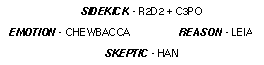
Most people would agree that Luke Skywalker is the Protagonist in Star Wars and Dramatica sees it the same way. The Empire itself, embodied in the Gran Mof Tarkin and his troops, is the force diametrically opposed to the story’s goal of destroying the Death Star, and is therefore the Antagonist. Obi Wan Kenobi is the Guardian, protecting Luke and company and providing “moral” guidance, whereas Darth Vader is the Contagonist, representing the temptation of the “Dark side of the Force” and hindering progress at every turn.

Han Solo functions as the Skeptic, arguing his disbelief in the Force as well as his opposition to just about every course of action anyone tries to take. R2D2 and C3PO jointly fill the role of Sidekick, forever faithful to whomever they are assigned. Princess Leia is Reason, coldly calculating (although this is tempered in the storytelling), calm-headed and the real planner of the group. Chewbacca, in contrast, responds frequently with little or no thought and acts solely on the basis of his feelings, which clearly defines him as Emotion.

(It should be noted that R2D2 and C3PO have a well developed sub-plot between them, that is forefront as the movie opens. This gives them much more personality and versatility, and spells out differences between them that would not occur if they both simply shared the sidekick function. Sub-plots are dealt with later in the Storyweaving section of this book.)

Drivers and Passengers in Star Wars

Having delineated our eight characters in Star Wars, let us organize them into Drivers and Passengers.

Driver Characters

Passenger Characters

From the Dramatica Theory Book

Blowing the Story Bubble

Remember blowing bubbles with that solution in the little bottles and the plastic wand? The craft of writing is a bit like blowing bubbles (life is like a box of chocolates!) This holds true not only for your dramatic approach, but also for the characters in your story as well.

The study of real bubbles is actually a science which combines physics, geometry, and even calculus! And, as with most natural phenomena, the dynamics that drive them have a parallel in psychology as well. For example, the math that describes a Black Hole in space can equally be applied to describing a prejudice in the mind.

So, by observing bubbles we can more easily grasp some otherwise intangible concepts about the psychology of stories and of the characters in them.

Turning our attention to stories, let’s look at several dramatic endeavors that can benefit by applying the qualities of bubbles. Bubbles burst. Sometimes you want them too, other times you don’t. The larger a bubble gets, the more impressive it is, but the more fragile as well. Until a bubble bursts the tension along its surface (surface tension) increases. But once it has burst, all the tension is gone. So the key is to blow the bubble as large as you can without exceeding the maximum sustainable tension. To do this, you need to know when to stop blowing, seal it off, and let it float on it’s own. In addition, you need to consider how hard to blow, how fast to blow, and to master the art of pulling away the wand to allow that magic moment when a bubble with a hole in it seals itself to become a perfect sphere.

When introducing a dramatic element into your story for the first time, consider how much material to work with at a single dramatic unit. Too little material tries to blow a bubble with not enough solution. It may not even make a film across the wand, and if it does, it will snap at the first breath before a bubble can form. Too much, and it drips off the wand, slobbering all over everything else, and snapping apart as well, because the sheer weight of the stuff makes the membrane too thick to flex. So, don’t work with dramatic units too large or small. Don’t focus on details too tiny or grand movements too large. Find the range and scope of your dramatic concepts that your readers or audience can hold onto while you pump it full of promise and then let it float into their hearts and minds on its own.

How hard you blow is equally important. As you may recall, blowing too hard will simply spit the solution right out of the wand and onto your parents’ carpet. (Why you chose to blow bubbles in the house even after having been told not to is no more fathomable than why you chose to be a writer, even though you knew better!)

Blow too soft, and your solution will just wiggle and vibrate in the wand, never bowing out to become a bubble at all. Eventually the solution in the wand will simply evaporate, and you’ll have spent a lot of time blowing with no bubble to show for it. Now a master storyteller can use this effect to his or her advantage. Get the right amount of solution on the wand and then just vibrate the blazes out of it with a gentle blow, tantalizing your audience, who is going to wonder if anything will every come of it. Just when it looks like the solution has almost evaporated too much to work, you pick up the airflow and form the bubble right before their eyes. Or, you might just keep it vibrating, a red herring, and simply let it dissolve out of the wand. Better be sure of your skills, though, because you want your audience to know you blew it, not to think you blew it.

And do you recall how if you blow at one intensity you get a single bubble, and if you blow with a different push you get a string of small bubbles? In fact, you can even get a series of medium bubbles if you find that narrow mid-range.

Dramatically, you can drop a lot of little bits of information, a few mid-sized bits of information, or one big bit, all with a single blow. (Killed 7 with one blow!). These are the Multi-Appreciation-Moments (M.A.M.) in which a single dramatic movement, passage, or discourse propels more than one dramatic element into the story.

Bubbles have size. The size of a bubble, in writing as in soap (or in writing “soaps”), depends primarily on the size of your wand and the huff in your blow.

Short stories are one size wand. Mini-series are another. Haiku are still one more. Each one has a maximum size of bubble it can produce, no matter how hard you blow. But size isn’t everything. There is such a thing as the beauty of perfection. Your idea is your solution, your format is your wand; try to make sure not to blow too hard for the wand/solution ratio you are using.

Surface Tension – wonderful phrase, that! Someone should use that for a title. More wonderful still is the way it works. Stories are about structure and passion. Your solution is about water and soap. Too much water and nothing happens. Too much soap and it all glops up. When you get the right mix of structure and passion, you’ve got the right raw material for a great bubble.

What holds the surface of the bubble together is the attraction among the soap and water molecules. What keeps it from collapsing is a slightly higher pressure on the inside than on the outside. A larger bubble has more tension because there is more surface. And yet, the total surface area of a collection of smaller bubbles far exceeds that of a single bubble occupying the same space. In addition, smaller bubbles are more stable, lasting far longer.

Use big bubbles for big events of singular identity with a limited life span. Use smaller bubbles collectively as a consistent foundation of longer duration.

Put your ear to the soap foam on dishwater or a hot bath, and though the mass remains largely constant, you can hear the satisfying snap, crackle, and pop of individual bubbles as they burst. Such formations can add stability to your story, even while providing an underlying level of surface tension, punctuated by hundreds of tiny eruptions. In addition, you can shape foam into all kinds of complex forms, while the shape of individual bubbles is far more limited.

While bubbles, on their own, are usually round, if you dip a bent piece of wire (such as a clothes hanger) in solution, you can create triangles, squares, and even approximations of hyper-cubes!

Although one might argue that the film from one wire side to the next does not comprise a bubble, and the enclosed area of such a shape does not either, guided by these outside influences a shaped bubble may indeed occur within the space bounded by the wires that doesn’t directly touch the wires. One shape, for example, may create a square bubble within another bubble. So, although the larger bubble is directly connected to the wires, the inner bubble is only connected to the planar surfaces of the outer bubble.

Ah, but I wax scientific. Fact is, the “set pieces” of your story are the wires dipped into your dramatic solution. An obvious heavy-handed control technique, you can also create very specific shapes by building those second-generation bubbles within bubbles, which are not formed by direct influence of your set pieces, but rather by indirect influence from being attached to those dramatics that ARE connected to the set pieces.

It’s a great point, but not for the faint of heart.

Bubbles combine. When two bubbles encounter each other, they might just bounce off like billiard balls. But if conditions are right, they join, creating a common interface between them. They are spherical except where they are joined, which becomes a flat side. More than two bubbles can combine, and when they do, all sorts of additional, symmetrical interfaces are created.

You entire story should be like a collection of bubbles, interfaced together. Each single bubble is another dramatic element or point. Over the course of your story you have blown them one by one until your story has fully taken shape. Then, on their one, one by one they begin to pop. Some of the solution is spattered away, some is absorbed by the remaining bubbles. Due to the extra solution, the remaining bubbles pop faster and faster until all the original bubbles have burst.

Let’s close by seeing how bubble science can help describe what your characters do you in your story. Suppose Sally calls on the phone complaining to Jane about a personal issue she is facing. Jane knows just what to say, but simply saying it will be rejected and not have the comforting effect she wants. In fact, Jane is smart enough to realize that she has to start out slow and easy, and over the course of the conversation blow a bubble of comfort big enough to enclose the problem.

So, with patience, Jane continues to talk to Sally, starting by enclosing a small part of the issue, then slowly expanding her support until it hold the whole thing inside. Now if Jane is too full of herself, has the habit of “beating a dead horse,” is emotionally needy herself and has to have confirmation from Sally that her problem is completely solved, or is just inexperienced, then she won’t know when to stop blowing and will continue pumping support into the conversation until the bubble gets so large it bursts.

But, if she knows what she’s doing, Jane will recognize when the bubble is big enough and then pull away the wand and stop blowing so that the sphere can form. She can do this by changing the subject, not off-topic, but to something tangential, to something touched upon in the conversation, but instead of talking about the part of that new topic that was connected to the personal problem, she now talks about other aspects of that topic that don’t involve Sally’s original issue.

Moving sideways in topic at the right time is like pulling the wand sideways from the bubble so that it can close.

Of course, Sally might be mired in her problem and stuck to the wand. But Anne may be in the room with Jane, hear that Sally is trying to come back to the original issue, and (being a good friend and student of psychology) realize another lateral move is needed. Anne would then raise her hand to get Jane’s attention (who would ask Sally to hold for a moment). Anne offers another off-topic comment based on what she has heard of the conversation. Jane passes the comment on to Sally on Anne’s behalf, and now Sally has been doubly distracted. At this point, either the bubble is free of the wand, or Sally simply won’t let go.

If the bubble is free, then it’s effect will remain within Sally long after the conversation and will work to resolve her angst. If it is not free, the air will just whoosh right back out of the wand and the bubble will deflate as if it never was, and Sally can go on moping about her problem.

Now, you might think this is all very complex, but it is this kind of bubble interaction that makes characters seem fluid rather than built of bricks. But do real people act like that? Sure they do. In fact, the very dramatic scenario I just described happened to me two days ago. That’s how I got the idea for this writing tip.

I was “Jane,” and with “Anne’s” perceptive interjection, I was able to assuage Sally’s angst, free the bubble, and Sally has been quite happy for the last 48 hours.

Real life psychology, character psychology, story psychology… the answer is blowin’ in the wind.

Melanie Anne Phillips

Dramatica Definition: Obstacle Character’s Solution

Obstacle Character’s Solution • [Element] • what is needed to truly satisfy The Obstacle Character’s drive • The Solution Element is the “flip side” of the Problem Element. For the Obstacle Character, it is the element that would alleviate the Obstacle Character’s drive which his Problem Element supplies. It is not necessarily applied during a story, but it exists in every story nevertheless.

From the Dramatica Dictionary

Driver and Passenger Characters

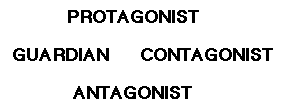
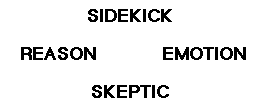
Four of the eight archetypal characters in Dramatica story theory are the prime movers of the story, and it is their interactions that determine the thrust of the effort to address the story’s problem. The other four are “back seat drivers” — perhaps highly interested in the outcome, but rather than forcing the plot, they influence those who do force the plot. Remember, these descriptions are only applicable in a general way but serve to make comparisons between similar traits of characters. In Dramatica, we group four similar items that are interrelated into a simple table called a quad. So, we can create a quad of Driver Characters and a quad of Passenger Characters.


The Driver Quad

In simple stories, the Protagonist, Antagonist, Guardian, and Contagonist are all major drivers of the story. Whatever the object of their efforts, Protagonist will be trying to achieve it, Antagonist will be trying to prevent its achievement, Guardian will act to aid the achievement, and Contagonist will act to hinder (although Guardian and Contagonist may not be directly concerned with the goal itself or even each other). Regardless of their personal levels of awareness, each of these Characters seen Objectively acts with a unique drive that represents a basic Motivation of the Story Mind.

For example, if the Protagonist wants to build a shopping center, the Antagonist will not want it built. The Contagonist might get an injunction delaying construction so it can profit from a stock deal, even though it may like to see the center built eventually, and the Guardian might find a legal loophole to overturn the injunction, perhaps just as a by-product of another matter it is representing in court.

Remember, these Objective Characters are not judged by how THEY see the story, but how WE see them affecting the story.

The Passenger Quad

Quad Two: The Passenger Characters

Unlike the first quad, these four Characters are not the prime movers of the story, but rather ride the coattails of the Driver Characters. If not for the Drivers, the Passengers would not even be involved with the problem. Each represents an approach or attitude in the story: Sidekick is forever faithful while Skeptic is forever doubting; Reason acts on the basis of logic and Emotion responds from feelings. Of course, each of these Characters also has its own motivations, but seen Objectively as part of the Story Mind they represent different approaches and attitudes toward solving the problem.

Before we sub-divide the Archetypal Characters into their basic Elements, let’s get a better feel for them by examining the Drivers and Passengers in several well known stories.

From the Dramatica Theory Book