Monthly Archives: June 2012

Dramatica Class: Characters – Change or Steadfast?

The following is excerpted from an online class on story structure presented by co-creator of the Dramatica theory of story, Melanie Anne Phillips, signed on as Dramatica:

Dramatica : Dramatica has four very important questions it asks about the Main Character. These questions are used by the software to arrange the relationships between character, plot, theme, and genre. Its kind of like a “Rubik’s” cube of story, as it were. These answers twist it into your unique arrangement.

Question one: Main Character Resolve. At the end of your story, has your Main Character changed or remained steadfast? Change or Steadfast is the question. Now some stories have a leap of faith where the M.C. must consciously choose to stick with their guns, or realize THEY might be the cause of the problems and CHANGE.

Scrooge is a change character. So is Luke Skywalker. Dr. Richard Kimble, or Job in the Bible are STEADFAST characters. Hollywood often has it that a character must CHANGE to grow. But Dramatica sees that a character can grow in their resolve as well. That’s why James Bond doesn’t seem to change but still works as a character. But there is always someone in the story who WILL change. In fact, if the Main Character changes, the Obstacle character will remain steadfast, If the Obstacle character changes, the M.C. will remain steadfast.

Who is Dr. Richard Kimble’s Obstacle? Who changes in The Fugitive? Any thoughts?

RDCvr : The policeman.

Dan Steele : Yes.

Dramatica : Right, Gerrard, the Tommy Lee Jones character. He starts out the first time he meets Kimble saying, “I don’t care!” And Kimble even brings it up to him in the police car at the end. And he says to Kimble, “Don’t tell anybody”, meaning that now he cares, he has changed. But Kimble didn’t! He never gave up… NEVER! In Goldfinger, if James Bond is steadfast,who changes? Who is the Obstacle Character?

Dan Steele : So one char. or the other HAS TO change their belief system by the end.

Dramatica : Yes, Dan, that is the nature of the author’s bias in the argument.

RDCvr : Goldfinger.

Dan Steele : Does Goldfinger dying count as a change in bel sys?

Dramatica : No, Goldfinger is an objective character – the Antagonist, in fact. Actually, Its Pussy Galore, the one who flies the plane – Honor Blackman.

Dan Steele : Oh, okay – yes

Dramatica : She changes from helping Goldfinger to helping Bond. Its not big, but it is there! It HAD to be there! Of course it is downplayed in an action story, and also the Obstacle character change is often underplayed because the M.C. is more important to the audience. But even Bond is asked at the end why she did it, and he replies, “I must have appealed to her maternal instincts”. It was important to make sure the audience knows that Bond was the one that changed her.

Dan Steele :So the antagonist provides the force against the main goal, but the obstacle char provides forces for belief system change?

Dramatica : Yes, Dan, exactly! That is the essence of the first question of Dramatica. Which kind of story do you want? The one where the M.C. sticks with their guns, or the story in which they are convinced to change? By making that choice, you not only know a lot more about your story and where it will go, but you have also had some impact on theme, plot, and genre as well. This doesn’t mean the M.C. will end up in a story filled with success. For example, by changing, they might give up just before they were about to win! So, outcome is a completely different thing. The question is not what they SHOULD do, but what they actually DO!

Dan Steele : So Resolve: change means MC sticks to guns, but Resolve:steadfast means either : 1) MC is convinced to change, or 2) MC changes another?

Dramatica : Right, Dan, that’s how it works.
Creating Characters: “My Hero!”

We’ve all heard the phrase, “the hero’s journey.” Much has been written about the steps in this journey and the nature of the hero himself. What is usually assumed is that the “hero” is an elemental character who possesses certain essential attributes. In fact, there are four truly essential attributes of the stereotypical hero:

1. He is the Protagonist

2. He is the Main Character

3. He is the Central Character

4. He is a Good Guy

Traditional writing theory uses these terms more or less interchangeably. But we are using them as descriptors of completely different attributes that make up the stereotypical “Hero.”

It really isn’t important what we names we use. What is important is that there are four distinct qualities that are combined to create a hero. So, if you use any of these terms in a different way, that’s fine. For our purposes, we need to (at least temporarily) agree on a common vocabulary so we can efficiently discuss the attributes themselves.

So, throughout this article we shall assume that the following definitions hold true:

The Protagonist is the Prime Mover in the plot – the chief driver toward the story’s overall goal.

The Main Character is the most empathetic character – the one with whom the audience most closely identifies; the character the story seems to be about.

The Central Character is the most prominent character – the one who stands out most strongly among the players.

The Good Guy is the moral standard bearer – the character whose intent is to do the right thing.

Putting it all together then, a hero drives the story forward, represents the audience position in the story, it the most prominent character, and tries to do the right thing.

Typical heroes include Dr. Richard Kimble in The Fugitive, Harry Potter, Clarice Starling in Silence of the Lambs, and Erin Brockavich.

Many writers are taught that they need to have a hero. Problem is, heroes in stories should be just about as rare as they are in real life. They do occur; they just aren’t the only option.

Now for the fun part…

These four heroic attributes aren’t necessarily tied together. In fact, they can be swapped for other attributes, distributed among several characters and even put together in different ways!

For example, suppose we change one attribute and create a character with the following four qualities:

1. Protagonist

2. Main Character

3. Central Character

4. Bad Guy

Now we have the typical anti-hero (in the popular vernacular). Such a character would drive the plot forward, represent the audience position in the story, be the most prominent, but represent a negative moral outlook.

Let’s try one more combination:

1. Antagonist

2. Main Character

3. Central Character

4. Good Guy

In this case, we have a character who is trying to prevent the story’s goal, represents the audience position in the story, is the most prominent, and tries to do the right thing.

James Bond is such a character. He did not instigate an effort; he is responding to an effort begun by the villain! In almost every Bond story, the villain is actually the driver of the plot – the proactive one – the Protagonist by definition, while James Bond is perpetually reactive, trying to put an end to the evil scheme.

In a future tip we’ll take apart the stereotypical “Villain” and see what he is made of!

Dramatica Class: Character Growth – Start or Stop?

The following is excerpted from an online class on story structure presented by co-creator of the Dramatica theory of story, Melanie Anne Phillips, signed on as Dramatica:

Dramatica : Question 2: about the Main character: Direction…. Start or Stop? This question means something different depending upon whether you answered change or steadfast. For a change Main Character, the question is: Do they have to grow by Starting something they aren’t doing, or stopping something they shouldn’t be doing? In other words, Do they have a chip on their shoulder or a hole in their heart?

We’ve all seen stories in which the M.C. is causing problem because of what they do, and other stories in which they allow a problem to grow because they don’t do anything! The Direction of character growth is just as important as Change or Steadfast. For a steadfast character, the question is different. Since the character is not changing, the question is, are they working or holding out for something to stop, or something to start?

In other words, is there a problem they are trying to get rid of, or is there something good they want to make happen. A simple question, but one that carries a lot of clout on your dramatics!

Dan Steele : Okay, makes sense.

A Story’s Limit: Timelock or Option Lock?

Dramatica : Now, I’ll jump ahead for a moment and look at a couple of plot questions…. First of all, is your story forced to a conclusion because your characters run out of time, or run out of options? This is Timelock or Optionlock. We all know what timelocks are…The ticking clock, 48 hours, etc. But what about stories like Remains of the Day? What was the time limit in that? There was none. So why didn’t the story go on forever? Because it was set up to have a limited number of opportunities for the characters to try and make a relationship happen. And when all the opportunities were exhausted, that’s when the story ends. Its important for the audience to know this right up front… they have to know the scope of the argument.

In Speed, the movie, they actually change from one lock to the other and this is confusing…The set up is, that the bomb will go off at 11:30 no matter what. So, the audience gets their sense of tension from the ticking clock. They expect that to be the moment win or lose will happen. All the other “constraints” about the speed of fifty miles per hour, and not being able to take anyone off the bus, are just that, constraints, but the bus could keep going forever with refueling, if it were not for the time bomb. But at the end of the story, what brings the moment of truth? Not the time bomb…. In fact, the bus slows down below fifty as it hits the plane. The LED numbers that are ticking down are the speed, not the time! So, the timelock is not honored.

Then we don’t know WHEN the story is going to end for sure. We assume maybe when the bad guy gets it. But that wasn’t where our tension was headed. Where the tension was built toward at the beginning, and therefore its something of a cheat and bit of a disappointment.

Dramatica : Actually, barring questions, I’ll have to stop there for now, as I have a class of 30 eager writers coming here to Screenplay for a class tomorrow morning.

Dan Steele : is “reception theory” the psychology of the audience?

Dramatica : Yes, Dan, its like this.. We, as an audience, can see pictures in clouds, wallpaper, constellations…We try to order our world, When we see a finished work, we look for pattern. Sometimes we see what the author intended, Sometimes things the author never intended that may or may not be in conflict with the intended message. And sometimes, we see no pattern at all. It may be the Storyform was flawed, missing apiece. Or it may be that the storytelling just didn’t convey it, or it may be that the audience just isn’t tuned into the symbols the author chose to use.

Complex Characters in “Rear Window”

Principal Characters in Rear Window

If there is anything that can be seen as “typical” about a Hitchcock film it would be his forefront use of thematics. Rear Window is no exception. As with Gone With the Wind, the enjoyment of the story comes largely from what happens between the lines. But unlike GWTW, the characters in Rear Window are relatively complex.

At first glance, it may seem that there are quite a few characters, what with the neighbors and all. There’s the Composer, trying to sell his first hit song. There’s Miss Lonely Heart, who can’t get a date. We see a lot of Miss Torso who exercises in front of her open window. Upstairs is the Couple With the Dog, downstairs, the Sunbather. And, of course, Thornton the murderer.

More prominent, of course, is Jeffries and the characters we see in his apartment: his girlfriend Lisa; Doyle, the detective; and his Nurse. (It is important to note that Thornton also shows up in Jeffries’ apartment near the end of the story and is the only neighbor to do so.)

The Top Five

The purpose of characters is to show how aspects of the Story Mind deal with a problem. And this is what determines that the neighbors are not Objective Characters. Aside from Thornton, they all have their own little stories, but only interact with each other peripherally, if at all. Their private stories enhance the thematic atmosphere of the overall story but neither advance nor clarify the plot.

If we eliminate all the neighbors who do not interact, we pare our list down to five actual characters: Jeffries, Lisa, Doyle, Nurse, and Thornton. If Rear Window is well written, we would expect all sixteen motivation Elements to be distributed among these five. Let’s see if they are.

Elements of the Top Five

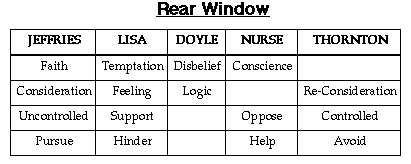
Who represents FAITH? Unquestionably Jeffries. He maintains his belief that a murder has been committed in the face of objections by each of the other characters. Lisa can’t talk him out of it and neither can his Nurse. Thornton denies it by his actions and Doyle is not convinced until after the proof is irrefutable. In fact, Doyle personifies DISBELIEF, even while HELPING Jeffries gain information to which he would not otherwise have access. Lisa comes around to accepting the possibility and so does Nurse. Thornton already knows the truth, but Doyle is never convinced until he sees the proof with his own eyes.

In addition, Doyle relies on LOGIC to support his disbelief. He will not accept Jeffries’ contentions without logical arguments. Then is Jeffries FEELING? No. Jeffries does not disregard Logic in his considerations; he merely can’t supply it. Jeffries urges the others to CONSIDER what he knows and what he suspects. Lisa, on the other hand, continually acts on impulse without regard for logic, illustrating nicely the characteristic of FEELING.

If Jeffries is CONSIDERATION, we would expect his nemesis, Thornton, to cause RECONSIDERATION, and he does. Thornton’s apparently guilt-free actions are a constant force that urges Jeffries (and the others) to RECONSIDER. All we ever see of him is that he acts methodically to carry out his plan, whatever that might be. It is his methodical approach that makes Thornton the CONTROL Character as well. He wastes no time or energy on anything but the task at hand, whereas Jeffries dabbles at whatever fills his view, even when it interferes with his goal of getting the goods on Thornton. Jeffries plainly illustrates the Element of being UNCONTROLLED.

Even though Lisa SUPPORTS Jeffries in his quest, she manages to HINDER his efforts through distraction and re-direction of their conversations. She clearly TEMPTS him to give up PURSUING this crazy scheme. In contrast, Jeffries’ Nurse OPPOSES his efforts, even while providing a moralistic philosophy or CONSCIENCE to his every comment. And, of course, Thornton would prefer to AVOID the whole thing.

Characteristic Lists

If we take a slightly different form, we can arrange the five Characters as column headings and list their characteristics beneath them.

Rear Window Characters in the Motivation Set

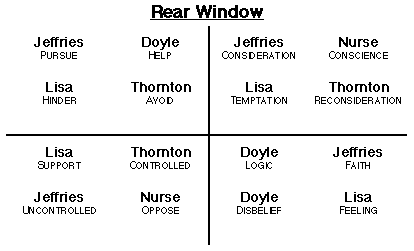
Assigning the Character names of Rear Window to the Motivation Characteristic Quads we get:

Using the grid above we can predict the principal conflicts of Rear Window simply by noting which characters are in Dynamic (diagonal) positions and the issues (Elements) over which each pair will diverge.

In summary, the set of sixteen Motivation Elements offers a valuable tool for understanding some of the essential building blocks of Objective Characters and how they can be distributed to create both Archetypal and Complex characters.

Dramatic Quads & Dramatic Pairs

In each quad of Elements, we find not only Dynamic (diagonal) Pairs, but horizontal and vertical pairs as well. Horizontal Elements are called Companion Pairs, and vertical Elements are Dependent Pairs. Each kind of pair describes a different kind of relationship between the Elements, and therefore between the characters that represent them.

In addition to the three types of pairs, we can look at each Element as a separate component and compare it to the overall nature of the quad itself. This Component approach describes the difference between any given Element and the family of Elements in which it resides (quad). Therefore, the degree of individuality the characters represent within the “group” can be explored.


Dynamic Pairs describe Elements with the greatest opposition to one another. Whenever two opposing forces come together they will create either a positive or negative relationship. They can form a synthesis and create something greater than the sum of the parts or they can simply tear away at each other until nothing is left (destructive). Within a quad, one of the Dynamic Pairs will indicate a positive relationship, the other a negative one. Which is which depends upon other story dynamics.

Companion Pairs contain the Elements that are most compatible. However, just being compatible does not preclude a negative relationship. In a positive Companion Pair, characters will proceed along their own paths, side by side. What one does not need they will offer to the other (positive impact). In a negative Companion Pair, one character may use up what the other needs. They are not against each other as in a negative Dynamic Pair, but still manage to interfere with each other’s efforts (negative impact).

Dependent Pairs are most complementary. In a positive sense, each character provides strengths to compensate for the other’s weaknesses (cooperation). Together they make a powerful team. In its negative incarnation, the Dependent Pair Relationship has each character requiring the other in order to proceed (codependency).

Components describe the nature of the Elements in relationship to the overall quad. On the one hand, the individual characters in a quad can be a group that works together (interdependency). The group is seen to be greater than the individual characters that comprise it, at the risk of overwhelming the individuality of its members. This is contrasted by identifying the disparate nature of each character in the quad (independency). Seen this way, the characters are noted for their distinguishing characteristics at the risk of losing sight of shared interests.

Dynamic Relationships are the most familiar to writers, simply because they generate the most obvious kind of conflict. Companion and Dependent Pairs are used all the time without fanfare, as there has previously been no terminology to describe them. Components are useful to writers because they allow characters in groups to be evaluated in and out of context.

By constructing characters with thought and foresight, an author can use the position of Elements in the Chess Set to forge relationships that are Dynamic in one dimension while being Companion and Dependent in others. Characters created with Dramatica can represent both the structural Elements of the Story Mind’s problem solving techniques and the dynamic interchange between those techniques.

The Villain

A villain is the dramatic antithesis of a hero, and therefore has the following four attributes:

  • He is the Antagonist
  • He is the Influence Character
  • He is second in prominence to the Central Character
  • He is a Bad Guy

By our definitions for this book: The Antagonist is the Principal Impediment in the plot – the chief obstacle to the achievement of the story’s overall goal.

The Influence Character is the most persuasive character – the one who argues the devil’s advocate position regarding the personal or moral issue the story seems to be about.

The Second Most Prominent Character is the one who stands out most strongly among the players, save for the hero.

The Bad Guy is the standard bearer of immorality – the character whose intent is to do the wrong thing.

Putting it all together then, a villain tries to prevent the goal from being achieved, represents the counterpoint to the audience position in the story, it the second most prominent character, and seeks to do the wrong thing. Now we can see that when we created a hero who was a bad guy and another who was an antagonist, we were actually borrowing attributes from the villain. In the same manner, the villain can borrow attributes from the hero. For example, we might fashion a character with the following four attributes:

  • Antagonist
  • Influence Character
  • Second Most Prominent
  • Good Guy

Such a character might be a friend of an anti-hero (who is a hero that is a Bad Guy), trying to prevent him from making a terrible mistake. Imagine that the anti-hero is trying to achieve a goal, represents the audience position, is most prominent, but has ill intent. The Good Guy variation on the villain would have good intent and would therefore try to thwart the anti-hero’s evil plan (antagonist), change his mind (impact character) and would be the second most prominent player next to the anti-hero.

Another variation on the typical villain might be:

  • Protagonist
  • Influence Character
  • Second Most Prominent
  • Bad Guy

In fact, it is this combination that is used most often in action/adventure stories. This character gets the ball rolling by instigating an evil scheme (protagonist/bad guy), tries to lure the “hero” to the evil side (influence character), but is second to the “hero” only in prominence.

As we can see, swapping attributes between the hero and villain opens up a world of opportunities for creating more interesting and less typical characters. But, these are not the only ways to swap attributes. For example, just because the hero is a Good Guy doesn’t mean the villain has to be a Bad Guy.

Suppose we have the following two characters:

Typical Hero:

  • Protagonist
  • Main Character
  • Central Character
  • Good Guy

Atypical Villain:

  • Antagonist
  • Influence Character
  • Second Most Prominent
  • Good Guy

Here we have a story about two people, one trying to accomplish something, the other trying to prevent it. One representing the audience position in the story, the other being the most influential with an opposing message argument. One is the most prominent; the other second in audience interest, but both believe they are doing the right thing.

These two characters are dramatically opposed. They are in conflict, both externally and internally. Yet each is driven to do what he believes is right. So who is right? Well, in fact, that is what a story built around these characters would be all about!

Indeed, the author’s message would center on convincing the audience that one of these characters was misguided and the other properly grounded. Such a story would provide an excellent opportunity to explore a moral issue that doesn’t easily fall into black and white clarity. It would stand a good chance to come across as deep, thoughtful, and provocative – and all by simply having two Good Guys duke it out.

At this point, it should be pretty clear that if you’ve only been writing with heroes and villains, you haven’t been doing anything wrong, but you have been limiting your creative opportunities. And yet, we have barely begun to explore the ways in which characters can swap attributes to create more variety and interest.

The Main Character

Of all four attributes of the hero, his role as the Main Character is perhaps the most intriguing. As described in an earlier writing tip, the Main Character represents the audience position in the story, and is the character with whom the audience most empathizes, the one whom the story seems to be about.

In the Story Mind, the Main Character represents our sense of self, the ego or identity of the story as a whole. So, always writing about heroic characters who are both Main Character and Protagonist is a lot like telling a story about football from only the Quarterback’s point of view and never from that of any of the other players.

In real life we are always the Main Character in our personal story, but we are not always the Prime Mover out of every one we know. Rather, we are usually supporting characters in the larger Goal, such as in a business, club, or church group, only occasionally being the driving force, leader, or initiator who others follow.

When we assign the attribute of Protagonist to one of the characters in our story but the role of Main Character to another, we open up a wealth of variations that better reflect the audience’s real life experiences. Such arrangements seem far less stereotypical and far more personal.

A Good example of this can be found in both the book and movie version of the classic story, To Kill A Mockingbird. This story is about Atticus, an open-minded lawyer in a small Southern town in the 1930s and his young daughter, Scout, who is trying to understand what is going on around her.

Atticus is the Protagonist as he tries to defend a black man wrongly accused of raping a white girl.

Scout is the Main Character because we see this story about prejudice through her eyes – a child’s eyes.

Fire Your Protagonist

Many authors start with a Protagonist and then build a cast of characters around him or her. But as a story develops, it may turn out that one of the other characters becomes more suited for that role. Sticking with the original Protagonist causes the story to become mis-centered, and it fails to take on a life of its own.

To see if this has happened to your story, try the following:

Take each of your characters, one by one, and try them out as the Protagonist. Give each a job interview. You ask them, “What would the story’s goal be if you were the Protagonist? What would you be working toward? What would you hope to achieve? How would you rally the other characters around your efforts?”

More than likely, you will find one character who seems just a little more driven – a character whose goal seems far more important than any of the others, one that not only affects him but all the other principal characters as well. That character should be your Protagonist, and it may not be the character you originally cast in that role. If it isn’t, fire your Protagonist and hire the new one!

Sure, you’ve become attached to the original character, but if he or she is no longer write for the job, well, business is business. You have to think about what is best for the entire company of players in your story without playing favorites.

Of course, with a new Protagonist, you’ll need to re-center your story and possibly to change the nature of the goal. But in so doing, your story will gain a renewed sense of purpose as this new character takes the helm.

Protagonist & Antagonist

Protagonist drives the plot forward.

Antagonist tries to stop him.

The Protagonist is the Prime Mover of the effort to achieve the Story’s Goal. The Antagonist is the Chief Obstacle to that effort. In a sense, Protagonist is the irresistible force and Antagonist is the immovable object.

In our own minds, we survey our environment and consider whether or not we could improve things by taking action to change them. The struggle between the Protagonist and Antagonist represents this inner argument: is it better to leave things the way they are or to try and rearrange them?

The Protagonist represents our Initiative, the motivation to change the status quo. The Antagonist embodies our Reticence to change the status quo. These are perhaps our two most obvious human traits – the drive to alter our environment and the drive to keep things the way they are. That is likely why the Archetypes that represent them are usually the two most visible in a story.

Functionally, the character you choose as your Protagonist will exhibit unswerving drive. No matter what the obstacles, no matter what the price, the Protagonist will charge forward and try to convince everyone else to follow.

Without a Protagonist, your story would have no directed drive. It would likely meander through a series of events without any sense of compelling inevitability. When the climax arrives, it would likely be weak, not seen as the culmination and moment of truth so much as simply the end.

This is not to say that the Protagonist won’t be misled or even temporarily convinced to stop trying, but like a smoldering fire the Protagonist is a self-starter. Eventually, he or she will ignite again and once more resume the drive toward the goal.

In choosing which of your characters to assign the role of Protagonist, do not feel obligated to choose one whose Storytelling qualities make it the most forceful. The Protagonist does not have to be the most powerful personality. Rather, it will simply be the character who keeps pressing forward, even if in a gentle manner until all the obstacles to success are either overcome or slowly eroded.

When creating your own stories, sometimes you will know what your goal is right off the bat. In such cases, the choice of Protagonist is usually an easy one. You simply pick the character whose storytelling interests and nature is best suited to the objective.

Other times, you may begin with only a setting and your characters, having no idea what the goal will turn out to be. By trying out the role of Protagonist on each of our characters, you can determine what kind of a goal the nature of that character might suggest.

By working out an appropriate goal for each character as if it were the Protagonist, you’ll have a choice of goals. Developing the plot of your story then becomes a matter of choosing among options rather than an exercise in the brute force of creating something from nothing.

What, now, of the Antagonist? We have all heard the idioms, Let sleeping dogs lie, Leave well enough alone, and If it works – don’t fix it. All of these express that very same human quality embodied by the Antagonist: Reticence.

To be clear, Reticence does not mean that the Antagonist is afraid of change. While that may be true, it may instead be that the Antagonist is simply comfortable with the way things are or may even be ecstatic about them. Or, he or she may not care about the way things are but hate the way they would become if the goal were achieved.

Functionally, the character you choose as your Antagonist will try anything and everything to prevent the goal from being achieved. No matter what the cost, any price would not seem as bad to this character as the conditions he or she would endure if the goal comes to be. The Antagonist will never cease in its efforts, and will marshal every resource (human and material) to see that the Protagonist fails in his efforts.

Without an Antagonist, your story would have no concerted force directed against the Protagonist. Obstacles would seem arbitrary and inconsequential. When the climax arrives, it would likely seem insignificant, full of sound and fury, signifying nothing.

In choosing one of your characters as the Antagonist, don’t be trapped into only selecting a mean-spirited one. As described earlier, it may well be that the Protagonist is the Bad Guy and the Antagonist is the Good Guy. Or, both may be Good or both Bad.

The important thing is that the Antagonist must be in a position in the plot to place obstacles in the path of the Protagonist. Since the drive of the Protagonist is measured by the size of the obstacles he or she must overcome, it is usually a good idea to pick the character who can bring to bear the greatest obstacles.

Ask yourself which of your characters would have the most to lose or be the most distressed if the goal is achieved. That will likely be your Antagonist. But don’t discount the other candidates out of hand. In storytelling, characters are not always what they seem. Even the character who seems most aligned with the Protagonist’s purpose may have a hidden agenda that makes them the perfect choice for Antagonist. You might play such a character as an apparent aid to the effort, and later reveal how that character was actually behind all the troubles encountered.