From the Dramatica Software Companion

From the Dramatica Software Companion
Perhaps the best way to instill real feelings in a character is to stand in his or her shoes and write from the character’s point of view. Unfortunately, this method also holds the greatest danger of undermining the meaning of a story.
As an example, suppose we have two characters, Joe and Tom, who are business competitors. Joe hates Tom and Tom hates Joe. We sit down to write an argument between them. First, we stand in Joe’s shoes and speak vehemently of Tom’s transgressions. Then, we stand in Tom’s shoes and pontificate on Joe’s aggressions. By adopting the character point of view, we have constructed an exchange of honest and powerful emotions. We have also undermined the meaning of our story because Joe and Tom have come across as being virtually the same.
A story might have a Protagonist and an Antagonist, but between Joe and Tom, who is who? Each sees himself as the Protagonist and the other as the Antagonist. If we simply write the argument from each point of view, the audience has no idea which is REALLY which.
The opposite problem occurs if you stand back from your characters and assign roles as Protagonist and Antagonist without considering the characters’ points of view. In such a case, the character clearly establish the story’s meaning, but they seem to be “walking through” the story, hitting the marks, and never really expressing themselves as actual human beings.
The solution, of course, is to explore both approaches. You need to know what role each character is to play in the story’s overall meaning – the big picture. But, you also must stand in their shoes and write with passion to make them human.
Melanie Anne Phillips
Co-creator, Dramatica
Optionlock • [Plot Dynamic] • the story climax occurs because all options have been exhausted • If not for the story being forced to a climax, it might continue forever. When a story is brought to a conclusion because the characters run out of options, it is said to contain a Optionlock. As an analogy, one might think of a story as the process of examining rooms in a mansion to find a solution to the story’s problem. Each room in the mansion will contain a clue to the actual location of the solution. In an optionlock, the Objective Characters might be told they can examine any five rooms they want, but only five. They must pick the five rooms ahead of time. They can take as long as they like to search each one and go thoroughly examine four of the rooms. After getting through their fourth pick they are given a choice: based on the clues they have found so far, do they wish to stick with their original fifth room or pick another room instead out of all that remain? Either choice may lead to success or failure, but because running out of options forced the choice it is an Optionlock story. This choice represents the Optionlock which brings the story to a close and forces such appreciations as Main Character Resolve (Change or Steadfast), Outcome (Success or Failure), and Judgment (Good or Bad).
From the Dramatica Dictionary
Each of the Eight Archetypal Characters contains one characteristic pertaining to actions and another characteristic pertaining to decisions.
PROTAGONIST
Action Characteristic: Pursues the goal. The traditional Protagonist is the driver of the story: the one who forces the action.
Decision Characteristic: Urges the other characters to consider the necessity of achieving the goal.
ANTAGONIST
Action Characteristic: The Antagonist physically tries to prevent or avoid the successful achievement of the goal by the Protagonist.
Decision Characteristic: The Antagonist urges the other characters to reconsider the attempt to achieve the goal.
GUARDIAN
Action Characteristic: The Guardian is a helper who aids the efforts to achieve the story goal.
Decision Characteristic: It represents conscience in the mind, based upon the Author’s view of morality.
CONTAGONIST
Action Characteristic: The Contagonist hinders the efforts to achieve the story goal.
Decision Characteristic: It represents temptation to take the wrong course or approach.
REASON
Action Characteristic: This character is very calm or controlled in its actions.
Decision Characteristic: It makes its decisions on the basis of logic, never letting emotion get in the way of a rational course.
EMOTION
Action Characteristic: The Emotional character is frenzied or uncontrolled in its actions.
Decision Characteristic: It responds with its feelings with disregard for practicality.
SIDEKICK
Action Characteristic: The Sidekick supports, playing a kind of cheering section.
Decision Characteristic: It is almost gullible in the extent of its faith — in the goal, in the Protagonist, in success, etc.
SKEPTIC
Action Characteristic: The Skeptic opposes — everything.
Decision Characteristic: It disbelieves everything, doubting courses of action, sincerity, truth — whatever.
Having split them in two, we can see that each of the Archetypal Characters has an attitude or Decision characteristic and an approach or Action characteristic. When we arrange both characteristics under each of the eight Archetypes in our Driver and Passenger Quad format, we get a graphic feel for the Archetypal Objective Characters and the Elements they represent.
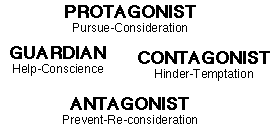
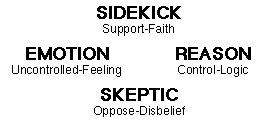
In Dramatica, we refer to these 16 characteristics as the Motivation Elements because they describe what drives the Archetypal Characters.
From the Dramatica Theory Book
In Dramatica theory, characters can grow by changing or by growing in their resolve to remain steadfast. But how does that translate to the real world? Here are some examples:
Change:
At the end of the story, the Main Character’s basic way of seeing things has changed from what it was at the beginning of the story. For example, a stubborn bounty hunter, who sees every criminal as “guilty,” changes to realize this isn’t true for every criminal and decides that he is chasing an innocent man; a woman who has always put her job before her family changes, and puts her family first by adapting her schedule so she can spend more time with her husband, even though it will mean missing a promotion; etc.
Steadfast:
At the end of the story, the Main Character’s basic way of seeing things has remained the same as it was at the beginning of the story. For example, a man wrongly accused of murdering his wife remains steadfast in his pursuit of the real killer believing this will eventually solve his problems; Despite all attempts to convert her, a woman remains true to her faith in her religion believing her God will protect her; etc.
From the Dramatica Pro Software
From the Dramatica Software Companion
A writer recently asked me the following question about feedback he received from the Dramatica software which suggested his character’s Purposes should be Knowledge and Actuality:
He wrote:
I don’t understand what Dramatica means by a character’s Purpose. Purpose in life?–Nobody knows what that is although some think they do. I understand Knowledge and Actuality as stated in Dramatica Dictionary. But I cannot put Purpose, knowledge, and actuality together in a meaningful, parallel context without Purpose meaning the same thing as Methodology, i.e., he uses “knowledge” and “reality”. I feel there is a SIMPLE explanation and I’m making it complex.
I replied:
In regard to “simplicity”, Dramatica theory is like Zen. There are simple explanations if all you want it a specific solution to a specific problem. But, the deeper you go, the more the simple explanations begin to form larger patterns until an overview of the whole durn mechanism of story begins to clarify. With that view comes a mastery of structure that guides creativity, channels it, but never inhibits it.
In regard to your particular problem…
First of all, Dramatica divides character into two aspects – the Subjective qualities, which represent character points of view (what the characters see) and Objective qualities, which represents how the characters function in the big picture.
From the Subjective view, one cannot see what can be seen from the “God’s Eye View” of the big picture – the view we can’t get in real life, the Objective view.
When answering questions about character Motivations, Methodologies, Evaluations, and Purposes, Dramatica is focusing on the Objective View. So, from that perspective of standing outside the story and looking in, we not only can, but MUST know our character’s Purposes. If we do not, how can we frame a cogent argument about the relative value of human qualities to our audience?
Of course, the Character will never see ANY of these aspects: not Motivations, Methods, Evaluations, nor Purposes. You see, the qualities that make us up are like the carrier waves of our self-awareness, the operating system of our personality, the foundation of our outlook. They describe where we stand, not what we are looking at. So, when choosing elements for your characters’ qualities, make sure to describe what each character really is, as seen from an Objective outside view. Describe how it functions, now how it feels. Describe how it is to be seen, not how it sees.
This phase of story creation is where you, as author, determine what the ACTUAL meaning of the story is, when all the smoke clears, when the audience can look back on the finished story and say, “This is what this character was really like – this is what kind of attributes he had, these are the human qualities it represents.”
Next, there is a common misunderstanding of what “Purpose” is. This actually occurs because writers often look at Purpose as if it were a Motivation. For example, if you ask an author what a character’s motivation is, he might say, “to be president.” But in fact, achieving the office of the presidency is his Purpose – simply defined as, what he hopes to accomplish, arrive at, or possess. His Motivation, on the other hand, is WHY he wants to be president. And, this might be any one of a number of things, such as that he never had any power as a child, or that he feels inadequate and needs the accolades. For any given Purpose, there can be any number of Motivations, and vice versa.
So, when choosing your characters’ Purposes, you need to ask yourself, what kinds of things (what categories of things) do I want this character, driven by his Motivations, to be trying to achieve? There are no limitations as to which Purposes can be the particular “goals” for any given motivations. In fact, it is the combination you choose that gives a unique identity to your character, either as an archetype where the Motivations are topically connected to similar associated Purposes or as more complex characters in which the Purposes are of completely different kinds of thing than the Motivations.
Now it might seem that a character will, in fact, see what his Purpose is. After all, if he wants to be president, he’s gotta be aware of that fact! True, but what he doesn’t see is that his UNDERLYING Purpose is “Actuality.” In such a story, there might be a character that is a power broker behind the scenes. He is the President de facto, because the actual president merely rubber-stamps our character’s decisions, and reads the speeches our character writes. But, our character’s Purpose is Actuality, so he feels as if he has achieved nothing. Only if he ACTUALLY becomes president will he ever feel he has accomplished his Purpose.
It is important to note that ANY of the Purpose Elements could show up in the story as “wanting to be president.” For example, “Knowledge” as a purpose could be written so that our character wants to KNOW what it is like to be president. He has stood next to the president, he can imagine what it is like, but unless he sits behind the desk in the Oval Office himself, he’ll never really KNOW.
So, using Knowledge and Actuality together, our character has Purpose of becoming president because he must Know what it is Actually like. ANY subject matter can be fit to ANY elements. This might seem as if nothing definitive is really being determined about your structure. In fact, it is the choice as to which elements are to be represented in the subject matter that give the subject matter a specific flavor, or spin, and thereby makes it more than simple storytelling. Only when the subject matter is presented as representing particular outlooks does it take on the mantle of dramatic significance. The matching of functional elements to the subject matter creates perspective, and it is perspective in which all dramatic meaning is held.
Again, like Zen, the exploration of story structure has many levels of depth and meaning. The more one learns about Dramatica and the Objective Character Elements, the more sophistication one develops in sculpting interesting characters of unusual identity yet valid composition. And it is upon such characters that a cogent and complete argument regarding the relative value of human qualities must be built.
A writer asks:
Hello. I’ve been using Dramatica Pro for about a year now. I’m developing a script for a graphic novel. (It may in fact be a series of three) I used [Dramatica’s] query engine in the early stages of development and have spent several months now writing (and drawing) deeper into the concept. I’m looking for practical suggestions for how to work back in DP: I still have not found the ONE storyform and instead am working between 3 storyforms as each one suggests thematic conflicts that describe the story in a very useful way. Do you have any suggestions for using specific reports or processes for working with three storyforms? There are so many ways to work with the program that I always feel I am overlooking some obvious tools…for example there may be a way to work with a particular set of reports.
Best Wishes,
Louise
My reply:
Hi, Louise.
The key is to note that each of Dramatica’s four throughlines has its own theme and its own thematic conflict. So, Main Character, Obstacle Character, Objective Story, and Subjective Story will each deal with different thematic issues.
This means you actually have four themes in every story form. They aren’t independent though – each is like a harmonic of the others. If a single theme hits a particular note, all four themes work in concert to create a chord. That’s why the four themes need to relate to each other in very specific ways.
So, you may find that if you look at all four throughlines, the three major themes you want to explore are already there.
Alternatively, many novels, especially graphic novels, are not really single stories but works in which a number of individual stories intertwine. As a result, there is not going to be a single storyform for the entire novel. Rather, each of the separate stories needs to be developed with its own storyform to ensure that its internal structural logic is complete and makes sense.
How these stories are woven together is really a storytelling decision – not a structural one, as long as each story makes sense and feels right in and of itself.
As for reports in Dramatica Pro, the “All Themes” report and the “Four Throughlines” report should help. You can also get the information your are looking for in the Story Points window for your storyform.
Melanie
Oppose • [Element] • dyn.pr. Support<–>Oppose • an indirect detraction from another’s effort • The Oppose characteristic causes a character to speak out against any effort, although he does not actively engage in preventing it. As in “the Loyal Opposition,” an opposing view can be useful in seeing the negative side of an endeavor. However it can also wear thin really fast with the constant nag, nag, nag. • syn. object to, speak out against, argue against, protest, dispute, show disapproval of, detract from
From the Dramatica Ditionary
There are 8 essential archetypal characters, each of which represents a different aspect of our own minds.
The Protagonist portrays our initiative, Antagonist our reticence to change. Reason is our intellect, Emotion our passion. Skeptic is our self-doubt, Sidekick our self-confidence. Finally, Guardian represents our conscience and the Contagonist is temptation.
Naturally, each must be developed as a complete person as well as in its dramatic function so that the reader or audience might identify with them. Yet underneath their humanity, each archetype illustrates how a different specific aspect of ourselves fares when trying to solve the problem at the heart of the story.
In this manner, stories not only involve us superficially, but provide an underlying message about how we might go about solving similar human problems in our own lives.
Here are the eight archetypal characters, described in terms of their dramatic functions:
PROTAGONIST: The traditional Protagonist is the driver of the story: the one who forces the action. We root for it and hope for its success.
ANTAGONIST: The Antagonist is the character directly opposed to the Protagonist. It represents the problem that must be solved or overcome for the Protagonist to succeed.
REASON: This character makes its decisions and takes action on the basis of logic, never letting feelings get in the way of a rational course.
EMOTION: The Emotion character responds with its feelings without thinking, whether it is angry or kind, with disregard for practicality.
SKEPTIC: Skeptic doubts everything — courses of action, sincerity, truth — whatever.
SIDEKICK: The Sidekick is unfailing in its loyalty and support. The Sidekick is often aligned with the Protagonist though may also be attached to the Antagonist.
GUARDIAN: The Guardian is a teacher or helper who aids the Protagonist in its quest and offers a moral standard.
CONTAGONIST: The Contagonist hinders and deludes the Protagonist, tempting it to take the wrong course or approach.
From the Dramatica Theory Book