Monthly Archives: July 2012

Dramatica Class: Main Character vs. Protagonist

The following is excerpted from a class on story structure presented by co-creator of the Dramatica theory of story, Melanie Anne Phillips, signed on as Dramatica.

Dramatica : The Main Character is not necessarily the Protagonist. First of all, a Protagonist is an archetypal character, and although archetypes work just fine, there are an infinite number of other kinds of more complex (and more simple) characters that can be created. But suppose we have a story with a Protagonist, and the Protagonist is NOT the Main Character… A story like To Kill a Mockingbird.

The Protagonist of a story is the driver of the Objective story. In other words, they are the most crucial soldier on the field. But we don’t have to see they battle always through their eyes. Just like we don’t always have to identify only with the quarterback in a football game. In To Kill a Mockingbird, Atticus, the Gregory Peck part in the movie, is the Protagonist. He is the driver of the Objective story – the story all the characters are concerned with. He is the one who wants to have the black man wrongly accused of rape freed. Do the two of you know the story?

Dan Steele : Unfortunately, not too familiar with the plotline.

RDCvr : Sort of, saw the movie a long time ago.

Dramatica : Well, the parts we are interested in are pretty simple, so it shouldn’t hold things up. The antagonist of the story is Bob Ewell, the father of the girl who was supposedly raped. He wants to have the man executed or at least lynched. But, the Main Character, the one through whose eyes we see the story through is Scout, Atticus’ little girl. The audience identifies with her, and even the camera angles in the movie are from her eye level whenever she is in a scene.

In this story, the Obstacle Character is not the antagonist either. The Obstacle character is Boo Radley, the “boogie man” from next door. The author of the work, in dealing with prejudice, did a very clever thing, in separating the Main and Obstacle from the Protagonist and Antagonist. No one wants to admit they are prejudiced. So, in the Objective story, the audience looks AT Atticus and Bob Ewell, and passes judgment on them. But at the same time, we are sucked into being prejudiced ourselves from the very first scene, because of the way Scout feels about Boo.

At the end of the story, we realize emotionally, that we were just as wrong as the objective characters were. Very clever technique! About to change subject, any questions?

Dan Steele : Okay, clear on the functions/differences of Main/Protagonist/Obstacle Chars.

Dramatica : Great!

RDCvr : what is the difference between obstacle character and antagonist?

Dramatica : The Antagonist tries to prevent the Protagonist from achieving the story’s goal, the Obstacle character tries to get the Main Character to change their belief system.

RDCvr : Okay.

Dramatica : They do this by building an alternative paradigm to the one the M.C. has traditionally used. More often than not, the M.C. and Protagonist characters are put in the same “body” and so are the Antagonist and Obstacle.

Dan Steele : Fine, but what if the antagonist is the protagonist, as in man against himself?

Dramatica : In Dramatica, we call any body that holds a character a player. Actually, you have touched on some very important theory points. First of all, when it comes to the Antagonist and Protagonist and all the other “objective” characters, the audience sees them “objectively” from the outside. Therefore, we identify them by their function in the story.

Again, we can feel for them, but we must see their function in order to understand the meaning of the battle. So, putting two objective functions that are diametrically opposed into the same player, mask the function of each, and make it VERY difficult to see what their purpose is. However, in stories like “Dr. Jeckyl and Mr. Hyde”, or Sibyl, there are many objective characters in the same body, but not at the same time!

In fact, each is identified as a separate character, and each has its day in the sun. But the Main and Obstacle characters are not identified by function, but by point of view. The Main Character is I to the audience, first person singular. The Obstacle character is you. Second person singular. So, the Antagonist might be the Main Character, or the sidekick, or the Guardian or any objective character.

Dan Steele : Hmm. Am wondering though how this copes with internalpsychological conflicts of a “tormented” Main character no, make that a Protagonist.

Dramatica : Well, the Main character, being a point of view is where all that internal conflict is seen.

RDCvr : But usually you also have external conflict which reflect or push the internal, no?

Dramatica : It is important to remember that when you combine a Protagonist in the same body as a Main character, the Protagonist part tries to drive the story forward to the goal, but the M.C. part is the INTERNAL conflict of the story, and can be full of angst.

Dan Steele : Okay.

Dramatica : They just don’t HAVE to be in the same body. Dramatica needed to separate the Objective or analytical part of the story’s argument, from the Subjective or passionate part of the argument in order to map out all of each side. In a finished story, of course, they are all ultimately blended together through storytelling.
Introduction to Theme

Theme is perhaps the most powerful yet least understood aspect of story structure.  Theme is an “emotional argument” that strives to lead the reader or audience to feel about a topic as the author would have them feel.

The reason structure of Theme appears so obscure is that it is actually two things, not one.  The first part of Theme is the Topic – the subject you are looking at (exploring).  The second part is Point of View.  When you adopt a point of view in regard to a topic, you create Perspective, and it is this perspective that holds the message or meaning of a story at the most passionate and most human level.  It is also where readers and/or audience members are most strongly moved, and where propaganda can be most effective without the knowledge of the recipient.

In this first episode of the 22 part class on Theme in the overall 113 part “Dramatica Unplugged” series, you’ll learn the basic foundations of theme and get a look forward to where our explorations will take us as the Theme class unfolds.

Story Outcome and Judgment

Your story’s “Outcome” is determined by success or failure in the attempt to achieve the overall goal.  But this is independent of whether or not everyone is feeling good about the outcome, even if success is achieved.  Often the costs of achieving a goal outweigh the benefits.  And in some stories, achieving a goal may turn out to be a hollow victory.

Similarly, failing to achieve the goal may not be an emotional distaster as well if the characters learn something of greater value or grow in ways that is far more meaningful than the failed attempt to achieve.  Put these in combinations and you get the Success/Good story (a triumph), the Failure/Bad story (a tragedy), the Success/Bad story (a personal tragedy), and the Failure/Good story (a personal triumph).

Using the two dramatic elements of Outcome and Judgment and adjusting the degree of success or failure and of personal fulfillment or devestation , one can create any variety of conclusion for a story from the “happy ending” to the “sad ending” and every bitter-sweet combination in between.

Character Development Tricks!

As trite as it might seem, ask yourself “What would a story be without characters?” The answer can help you get a grip on exactly what characters really do in a story, and therefore how to build them effectively.

Although it is possible to write without the use of characters, it is not easy. Characters represent our drives, our essential human qualities. So a story without characters would be a story that did not describe or explore anything that might be considered a motivation. For most writers, such a story would not provide the opportunity to completely fulfill their own motivations for writing.

For example, we might consider the following poem:

Rain, rain, go away.

Come again another day.

Are there characters in this short verse? Is the rain a character?

To some readers the poem might be a simple invocation for the rain to leave. To other readers, the rain may seem to be stubborn, thoughtless, or inconsiderate. Of course we would need to read more to know for certain.

Suppose we wrote the sentence, “The rain danced on the sidewalk in celebration of being reunited with the earth.”

Now we are definitely assigning human qualities to the rain. Without doubt, the rain has become a character. Characters do not have to be people; they can also be places or things. In fact, anything that can be imbued with motivation can be a character.

So, a fantasy story might incorporate a talking book. An action story might employ a killer wolverine. And a horror story might conjure up the vengeful smoke from a log that was cut from a sentient tree and burned in a fireplace.

When we come to a story we either already have some ideas for a character or characters we would like to use, or we will likely soon find the need for some. But how can we come up with these characters, or how can we develop the rough characters we already have?

Coming up with characters is as simple as looking to our subject matter and asking ourselves who might be expected to be involved. But that only creates the expected characters – predictable and uninteresting. Making these characters intriguing, unusual, and memorable is a different task altogether. But first things first, let us look to our subject matter and see what characters suggest themselves. (If you like, try this with you own story as we go.)

Example:

Suppose all we know about our story is that we want to write an adventure about some jungle ruins and a curse. What characters immediately suggest themselves?

Jungle Guide, Head Porter, Archaeologist, Bush Pilot, Treasure Hunter

What other characters might seem consistent with the subject?

Missionary, Native Shaman, Local Military Governor, Rebel Leader, Mercenary

How about other characters that would not seem overly out of place?

Night Club Singer, Tourist, Plantation Owner

And perhaps some less likely characters?

Performers in a Traveling Circus (Trapeze Artist, Juggler, Acrobat, Clown)

We could, of course, go on and on. The point is, we can come up with a whole population of characters just by picking the vocations of those we might expect or at least accept as not inconsistent with the subject matter. Now these characters might seem quite ordinary at first glance, but that is only because we know nothing about them. I promised you a trick to use that would make ordinary characters intriguing, and now is the time to try it.

Of course, we probably don’t need that many characters in our story, so for this example let’s pick only one character from each of the four groups above: Bush Pilot, Mercenary, Night Club Singer, Clown.

First we’ll assign a gender to each. Let’s have two male and two female characters. Well pick the Bush Pilot and the Mercenary as male and the Night Club Singer and the Clown as female.

Now, picture these characters in your mind: a male Bush Pilot, a male Mercenary, a female Night Club Singer, and a female Clown. Since we all have our own life experiences and expectations, you should be able to visualize each character in your mind in at least some initial ways.

The Bush Pilot might be scruffy, the Mercenary bare-armed and muscular. The Night Club Singer well worn but done up glamorously, and the Clown a mousy thing.

Now that we have these typical images of these typical characters in our minds, let’s shake things up a bit to make them less ordinary. We’ll make the Bush Pilot and the Mercenary female and the Night Club Singer and Clown male.

What does this do to our mental images? How does it change how we feel about these characters? The Bush Pilot could still be scruffy, but a scruffy woman looks a lot different than a scruffy man. Or is she scruffy? Perhaps she is quite prim in contrast to the land in which she practices her profession. Since female bush pilots are more rare, we might begin to ask ourselves how she came to have this job. And, of course, this would start to develop her back-story.

How about the female Mercenary? Still muscular, or more the brainy type? What’s her back story? The Night Club Singer might be something of a lounge lizard type in a polyester leisure suit. And the male Clown could be sad like Emit Kelly, sleazy like Crusty the Clown, or evil like Pennywise the Clown in Stephen King’s “It.”

The key to this trick is that our own preconceptions add far more material to our mental images than the actual information we are given – so far only vocation and gender.

Due to this subconscious initiative, our characters are starting to get a little more intriguing, just by adding and mixing genders. What happens if we throw another variable into the mix, say, age? Let’s pick four ages arbitrarily: 35, 53, 82, and 7. Now let’s assign them to the characters.

We have a female Bush Pilot (35), a female Mercenary (53), a male Night Club Singer (82), and a male Clown (7). How does the addition of age change your mental images?

What if we mix it up again? Let’s make the Bush Pilot 7 years old, the Mercenary 82, the Night Club Singer 53, and the Clown 35. What do you picture now?

It would be hard for a writer not to find something interesting to say about a seven-year-old female Bush Pilot or an eighty-two year old female Mercenary.

What we’ve just discovered is that the best way to break out of your own mind and its cliché creations is to simply mix and match a few attributes. Suddenly your characters take on a life of their own and suggest all kinds of interesting back-stories, attitudes, and mannerisms.

Now consider that we have only been playing with three attributes. In fact, there are hundreds, perhaps thousands of attributes from which we might select. These might include educational level, race, disabilities, exceptional abilities, special skills, hobbies, religious affiliation, family ties, prejudices, unusual eating habits, sexual preference, and on and on. And each of these can be initially assigned in typical fashion, then mixed and matched. Using this simple technique, anyone can create truly intriguing and memorable characters.

Perhaps the most interesting thing in all of this is that we have become so wrapped up in these fascinating people that we have completely forgotten about structure! In fact, we don’t even know who is the Hero, Protagonist, or Main Character!

Many authors come to a story realizing they need some sort of central character and then try to decide what kind or person he or she should be from scratch. But it is far easier to first build a cast of characters that really excite you (as we did above) and then ask yourself which one you would like to be the central character.

So, imagine…. What would this story be like if we chose the seven-year-old female Bush Pilot as the Hero. How about the eighty-two year old female Mercenary? Can you picture the 53-year-old male Night Club Singer as Hero, or the thirty-five year old male Clown?

And how would things change depending upon who we pick as the Villain or Antagonist? In fact, by choosing one of these characters as the Hero and another as Villain it will begin to suggest what might happen in the plot, just as picking the subject matter suggested our initial characters. Writer’s block never has to happen. Not when you are armed with this technique to spur your passions.

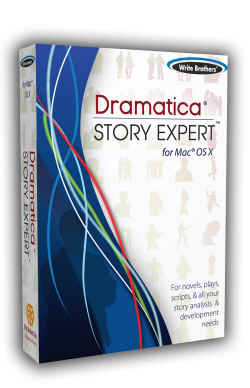
The New Dramatica for Macintosh is Finally Here!

Ten years in development since the release of Dramatica Pro 4 comes the next generation of story structuring and story development software for Macintosh: Dramatica Story Expert!

Built around the same patented Story Engine, Dramatica Story Expert is bursting with new tools and features that will once again revolutionize the process of story creation for novelists, screenwriters and playwrights.

Visit the Dramatica Story Expert Product Page to learn all about the new and enhanced features!

Upgrade for just $69.95

Full Version for $169.95

Windows version expected in Spring 2013

Beyond Dramatica – a new free eBook by Dramatica co-creator Melanie Anne Phillips

Introducing a new free eBook by Dramatica co-creator Melanie Anne Phillips that explores how insights from the Dramatica Theory of Story can be applied to real world psychology, both for the individual and for society.

Click here to download “Beyond Dramatica” for free in PDF

Click here to download “Beyond Dramatica” Kindle format for $0.99

From the Preface:

In 1994, the book Dramatica: A New Theory of Story was first unveiled to the writing community and almost instantly revolutionized the way authors understood and constructed stories.  Since then, its techniques have been employed by Pulitzer Prize winning authors, academy award winning writers and directors, and producers of some of the most innovative series on television.

Melanie Anne Phillips, co-creator of the Dramatica theory, has written hundreds of articles describing Dramatica’s concepts and their application to practical story development.  But Dramatica is more than just a writer’s tool to construct fictional stories; by its very nature it has implications in the realm of human psychology at large.  This book gathers together some of the most insightful articles by Melanie on the application of Dramatica to the real world.

Assembled and edited by Dramatica expert Sandy Stone, this collection has been organized to provide useful new perspectives on how human thought functions, both individually and societally.

So, put away your preconceptions and prepare to have your eyes opened to a whole new approach to some of the most intriguing questions of our time.

Featured articles include: Storyforms in the Real World and the Mobius Doughnut, Fractal Psychology in the Real World, Narrative Space in the Real World, Dramatica and the Brain, Dramatica Theory Application on World Problems, al-Awlaki, the “Uncanny Valley” and Writing Empathetic Characters, Watson and Dramatica: Building an Artificial Mind, and more!