64. The 28 “Magic” Scenes (Part One)
65. The 28 “Magic” Scenes (Part Two)
66. The 28 “Magic” Scenes (Part Three)
67. The 28 “Magic” Scenes (Part Four)
What Is A Sequence?
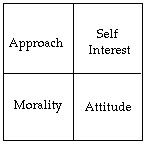
Sequences deal with a quad of Variations much as Acts deal with a quad of Types. The quad we will be interested in is the one containing the Range, as that is the item at the heart of a throughline’s Theme. Returning to our example story about an Objective Story Throughline in the Physics Class with a Concern of Obtaining, we shall say the Range is Morality, as illustrated in the quad below.
If Morality is the Range, then Self-Interest is the counter-point. Theme is primarily derived from the balance between items. When examining the quad of Variations containing the Range, we can see that the Range and counter-point make up only one pair out of those that might be created in that quad. We have also seen this kind of balance explored in the chapter on Character where we talked about three different kinds of pairs that might be explored: Dynamic, Companion, and Dependent.
Just as with character quads, we can make two diagonal pairs, two horizontal pairs, and two vertical pairs from the Variations in the Range quad. For the Morality quad, these six pairs are Morality/Self-Interest, Morality/Attitude, Morality/Approach, Self-Interest/Attitude, Self-Interest/Approach, and Attitude/Approach. Each of these pairs adds commentary on the relative value of Morality to Self-Interest. Only after all six have been explored will the thematic argument will have been fully made. It could go in a manner as follows:
Morality/Self-Interest
On face value, which appears to be the better of the two?
Morality/Attitude
When Morality is the issue, how do we rate the Attitude of those espousing it?
Morality/Approach
When Morality is the issue, how do we rate the Approach of those espousing it?
Self-Interest/Attitude
When Self-Interest is the issue, how do we rate the Attitude of those espousing it?
Self-interest/Approach
When Self-Interest is the issue, how do we rate the Approach of those espousing it?
Attitude/Approach
Overall, which should carry more weight in regard to this issue?
By answering each of these questions in a different thematic sequence, the absolute value of Morality compared to Self-Interest will be argued by the impact of the six different relative values.
How Sequences Relate To Acts
Three Act Progressions
With six thematic Sequences and three dynamic Acts, it is not surprising that we find two Sequences per Act. In fact, this is part of what makes an Act Break feel like an Act Break. It is the simultaneous closure of a Plot Progression and a Theme Progression. The order in which the six thematic sequences occur does not affect the message of a story, but it does determine the thematic experience for the audience as the story unfolds. The only constraints on order would be that since the Range is the heart of the thematic argument, one of the three pairs containing the Range should appear in each of the three dynamic Acts. Any one of the other three pairs can be the other Sequence.
Four Act Progressions
The three dynamic Acts or Journeys in a throughline’s plot represent the experience of traversing the road through the story’s issues. The four structural Acts are more like a map of the terrain. As a result, a more structural kind of thematic Sequence is associated with the Types directly.
Beneath each Type is a quad of four Variations. From a structural point of view, the Act representing each Type will be examined or judged by the four Variations beneath it. In our ongoing example, the Act dealing with Obtaining would be examined in terms of Morality, Self-Interest, Attitude, and Approach. The difference between this and the thematic sequences we have just explored is that Obtaining is judged by each Variation in the quad separately, rather than each Variation in the quad being compared with one another. It is an upward looking evaluation, rather than a sideways looking evaluation.
In this manner, a thematic statement can be made about the subject matter of concern in each of the four structural Acts. The six Sequences constitute an argument about the appropriateness of different value standards.
Scenes
By the time we get down to scene resolution, there are so many cross-purposes at work that we need to limit our appreciation of what is going on in order to see anything in the clutter. First, however, let’s touch on some of the forces that tend to obscure the real function of scenes, then strip them away to reveal the dynamic mechanism beneath.
Resolution and Sequence
Earlier we spoke of plot in terms of Types. We also speak of plot here in terms of four resolutions: Acts, Sequences, Scenes, and Events. Both of these perspectives are valid appreciations depending on the purpose at hand. Because all units in Dramatica are related holographically, no single point of view can completely describe the model. That is why we select the most appropriate view to the purpose at hand. Even though looking at plot in terms of Types is useful, it is true that “plot-like” twists and turns are going on at the scene resolution as well. However, these dynamics are not truly part of the scene, but merely in the scene. An Act, Sequence, Scene, or Event is really a temporal container — a box made out of time that holds dynamics within its bounds. Much like filters or gratings with different-sized holes, the resolutions “sift” the dynamics trapping large movements at the highest levels and allowing smaller nuances to fall all the way down to the Elements.
What’s in a Scene?
At the scene resolution, the effects of Types and Variations can be felt like the tidal pull of some distant moon. But scenes are not the resolution at which to control those forces. Scenes are containers that hold Elements — anything larger cannot get crammed in without breaking. So the richness we feel in scenes is not solely due to what the scene itself contains, but also to the overall impact of what is happening at several larger scales.
What then does a scene contain? Scenes describe the change in dynamics between Elements as the story progresses over time. And since Elements are the building blocks of characters, scenes describe the changing relationships between characters.
Characters and Scenes
Characters are made up of Motivations, Methodologies, Means of Evaluation, and Purposes. These terms also describe the four major sets of Elements from which the characters are built. The driving force of a character in a given scene can be determined, such as whether their argument is over someone’s motivations or just the method they are employing.
6 Goes Into 24 Like Theme Goes Into Scenes
We have spoken of the three and four act appreciations of story. It was illustrated how both divisions are valid to specific tasks. When dealing with scenes, we find that no scenes ever hang between two acts, half in one and half in the other, regardless of a three or four act appreciation. This is because there are exactly 24 scenes created at the Element level: six per act in a four act appreciation, eight per act in a three act appreciation. In both cases, the scenes divide evenly into the acts, contributing to the “feel” of each act break being a major turning point in the progress of the story.
Sequences, on the other hand, exist as a six part partition of the story. Therefore, they divide evenly into a three act appreciation but not into a four. Since the four act view is objective, sequences — as they define Thematic movements — are truly an experiential phenomenon in the subjective appreciation and lose much of their power objectively.