Theme
Prologue
Before the final version of “Dramatica – a New Theory of Story” there was an earlier draft which contained unfinished concepts and additional theory that was ultimately deemed “too complex”. As a result, this material was never fully developed, was cut from the final version of the book, and has never seen the light of day — until now! Recently, a copy of this early draft surfaced in the theory archives. The following are excerpts from this “lost” text.
CAVEAT:
Because the text that follows was not fully developed, portions may be incomplete, inaccurate, or actually quite wrong.
It is presented as a look into the history of the development of Dramatica and also as a source of additional theory concepts that (with further development) may prove useful.
What is Theme?
Of all the areas of story that have been examined and employed, Theme is perhaps the most elusive. Clearly, much of a story’s “feel” is due to the Thematic nuances that color the scenes and shade the plot. Yet, previous attempts to describe Theme have achieved little success. Fortunately, the concept of the Story Mind once again provides insight to the specific meaning and function of story elements, in this case enabling the first truly definitive description of what Theme really is, how it works, and how to use it.
Just as the Objective and Subjective Characters are seen to have Motivations, Methodologies, Means of Evaluation and Purposes, so too does the Story Mind. The relationship of the Characters to the Story Mind is such that all four of these levels of Character make up only the Motivations of the Story Mind. Let’s explore this more fully.
According to Dramatica, each story represents a single mind dealing with a particular problem. This Story Mind contains within it all the elements, structures and dynamics of the story. The audience is afforded two views of the Story Mind: the Objective View and the Subjective View. It is the comparison and convergence of these two views that creates the potential to drive the story forward.
So, we have two views, and a comparison of those views. In effect, the comparison is a view of its own, a synthesized dimensional perspective of the Story Mind that consists of a blending of the Objective and Subjective views.
When we look at the attributes of the story as a whole, in effect the attributes of the Story Mind, all elements of Character become the collective force that drives the story forward, in essence the Story Mind’s Motivation. Just as we are all driven by many independent forces that ultimately coalesce into a single Motivation to do or do not, all of the Characters in a story represent these many and varied drives that combine to Motivate the Story Mind and force the progress of the story (the problem solving process of the Story Mind).
As illustrated earlier, Motivations alone do not provide a complete system or circuit. On of the other ingredients needed is a direction in which to apply that Motivation. Without direction, motivation would simply be dissipated, working against itself in all directions randomly. When we get a “feel” for the theme of a story, we are really looking at the synthesized view that is the Story Mind’s Purpose.
Just as the elements of Character come in Dynamic Pairs, so do the Elements of Theme. To prevent confusing the two, Dramatica calls the Thematic Elements Variations.
The difference between Elements and Variations is one of appreciation, meaning that the difference is not in their natures so much as the way we interpret them. This clearly explains why Theme has traditionally been so difficult to pin down: because it cannot be defined by content, but by usage.
As soon as we understand that Variations represent the Story Mind’s Purpose, how to appreciate them becomes much easier. The best way to get a feel for the Variations is to see some in Dynamic Pair Relationships. Here is one quad of four Variations.
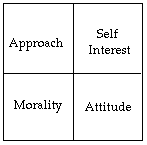
So many stories come readily to mind when examining the Variations. Morality vs. Self Interest, Attitude vs. Approach: how many times have we seen these Thematic conflicts explored? That is why the Variations are in Dynamic Pairs – because the Story Mind is torn between two contradictory Purposes and must choose one at the point of the Leap of Faith.
Which is better, Morality or Self-Interest? Well that depends on your point of view, doesn’t it. It is easy to imagine a scene where it is more “correct” to lay down one’s life for the good of the group, but it is just as easy to imagine a scene where one must stand up against the common code and be an individual. The point here is that neither Morality, Self-Interest or any of the Variations is “better” or more proper than another. Rather, in a specific story, one Variation in a pair will be seen to be more appropriate to the situation at hand.
Creating a Thematic Message
Variations are where an Author makes her statement – the place where the message of the story is defined. There are four sets of sixteen Variations that are commonly applied in the most popular story structures. Only one set contains the message of a given story. When you pick a Set of Variations, you have selected the subject matter that your story will be about, and the nature of the deliberations of the Story Mind.
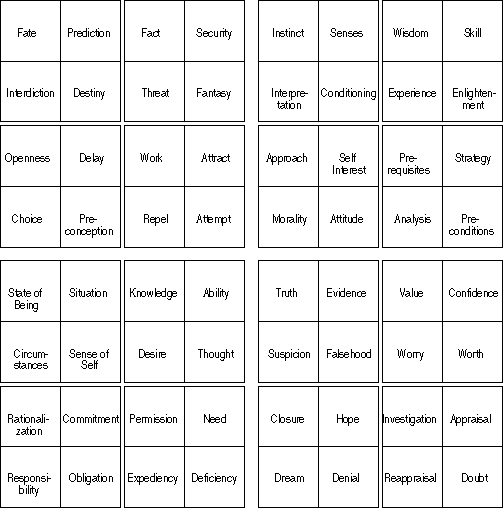
As we can see, each set has a distinct flavor to it, and the choice of which set to employ has far ranging effects on the shadings and nuance of a story. When selecting a set, one Quad will ultimately serve as the focus of the message. For example in the Universe Set, one might tell a story that focuses on Morality, Self-Interest, Approach, and Attitude. Or, an author might elect to make a point about Instinct, Conditioning, Senses, and Interpretation. Any of the sixteen Quads that make up the sixty four Variations are equally suited to conveying a message. But for a given author, some Quads will be more appealing than others.
So, the first job in creating the Theme of a story is to select a Quad that will serve as the message focus. As a simple example, lets pick Morality, Self-Interest, Approach, and Attitude. Now one of those Dynamic Pairs will constitute the Thematic Conflict of our story. Again picking a common choice, we’ll select the argument over Morality vs. Self-Interest as the Thematic Conflict of our story.
What this means is that the Theme of Morality vs. Self-Interest will run throughout our story. This is the principal consideration that all the hullabaloo is a about. Of course, some stories concentrate on the Theme and other stories concentrate on the Characters, but EVERY story must have both, represented to some degree of prominence.
Here is where the difference between story and storytelling is clearly drawn, and also where the flexible nature of the Dramatica Model becomes apparent. Say we had selected Morality vs. Self-Interest as the Thematic Conflict of our story. How many ways could we think of to illustrate it? Quite a few! Taking candy from a baby, cheating on a test, a psychologist taking advantage of a female patient, spending your mad money on new shoes for the kids, allowing someone else to be blamed for something you did – all of these illustrate that conflict.
So, not only were we provided the choice of which Conflict to focus on, we also have an unlimited number of ways we could illustrate it. The important thing is that Morality forms a Dynamic Pair with Self-Interest, not with Interpretation, Wisdom, Strategy or any other. Certainly there is some kind of relationship between them, but not the pure antithesis of the Dynamic Pair. In fact, the relationship between any two Elements or any two Variations is consistent with their overall position relative to one another, which is why the Dynamic Pair is the most elemental relationship of conflict.
Now every Quad has two Dynamic Pairs, whenever one pair is selected as a dramatic potential (like Thematic Conflict) the Co-Dynamic Pair functions as a potentiometer to control and vary the intensity of the conflict. A Thematic Conflict of Morality vs. Self-Interest would be modulated by Approach and Attitude, the Co-Dynamic Pair. For Instinct vs. Conditioning the potentiometer will be Senses and Interpretation.
Since we can pick any dynamic pair as the Thematic Conflict, we might instead choose Approach vs. Attitude as the conflict, which would then be adjusted by the interactions of Morality and Self-Interest.
Since Theme is a synthesis in the mind of the audience, the way to achieve that synthesis is not to try and portray the Thematic Conflict directly, but to portray the Co-Dynamic Pair – the potentiometer – in the story. Then, the conflict that is being controlled is formed in the mind of the audience.
For example, let’s make our Thematic Conflict State of Being vs. Sense of Self. State of Being means the actual kind of person someone is. Sense of Self is their self image. To vary the intensity of the conflict between self image and actual state of being, we create a discrepancy between this Character’s Situation and their Circumstances.
If we make a Character’s Situation that they are a big city doctor, and the Circumstances that they are constantly brow beaten, the relationship between the Co-Dynamic Pair of Situation and Circumstances would drive up the potential between State of Being and Sense of Self. But if we make her a big city doctor who is revered by all, it makes the potential for Thematic Conflict nearly zero. We could also make her a lowly medical trainee, who is brow-beaten, and also bring to nearly zero the Thematic Conflict between State of Being and Sense of Self.
Simply put, the potential between the Variations in the Co-Dynamic Pair creates and adjusts the potential between the Variations in the Thematic Conflict.
Stories always appear to be heavy handed when the Thematic Message is driven home too directly. This happens when an author tries to make her point with the actual Variations of the Thematic Conflict. But when an author uses the Co-Dynamic Pair of Variations to control the potential, the Thematic Message of the story is created powerfully and gracefully in the mind of the audience as a synthesis. The point is never stated directly, merely alluded to. And that is the strength of Theme and the strength of Dramatica’s ability to define it.
Developing a Theme
Thinking of Theme as the “message” of a story gives a good idea of its purpose, but provides no indication about how to relate that message. Theme is not just something that springs full-grown from the story, or is simply flat-out stated, but must be developed, explored, and proven. This is not an arbitrary task. The nature and order of the Thematic Progression is absolutely interrelated to many other choices an Author makes.
Notice we are taking the first step into a new phase of Dramatica. So far we have talked only about arrangement, but now we are talking about progression. Arrangement is an appreciation of the Story Mind based on how things are ordered in Space. Progression is an appreciation of the Story Mind based on how things are ordered in Time.
Anyone familiar with writing knows that both Space and Time play a role in the creation of a story. In Dramatica, Space and Time are two different ways of looking at the same thing. A similar phenomenon would be the particle and wave nature of light. In certain instances (like with reflections) it is more practical to deal with light as if it were only a particle. This is a Spatial view and is quite useful in many ways. But not all ways. In an equal number of instances the wave view is best (such as when explaining interference patterns). This is a Temporal view. The point is: light can be seen as both a particle and a wave and these nature’s coexist. Yet sometimes is it more useful to see it as one rather than the other.
Similarly, Story can be appreciated as an arrangement or a progression. In truth, they coexist at all times. But sometimes one view is more useful than the other. So, when describing the Thematic Message of a story, we are describing the nature of a Spatial object: something that is unchanging throughout the story. But when we look at the progression of the development of that message, we are taking a Temporal view to see it as a process.
Time, in the Story Mind is manifested in many ways. The most broadly drawn is Act Order. As an introduction to time flow in the Story Mind, and as a means of describing Thematic Progression, we’ll limit ourselves to that least complex level first. In later chapters we shall see how time flow as well as spatial arrangement, are both important aspects of the development of not only Act structure, but scene structure and even the subject matter contained within the scenes.
Again, Dramatica does not dictate the specific content, order, or arrangement. Rather, it simply makes sure that the choices an author makes are consistent with one another.
The first step in looking at the progression of Thematic Development at the Act level, is to answer the age-old question: How many Acts are there in a story? Three? Four? Dramatica’s answer is: Both!
Sounds pretty non-committal, doesn’t it? No, its just more of the particle/wave kind of effect. Reconsider for a moment, what we have learned about the Subjective and Objective views: that both are looking at the same thing and just seeing it from a different perspective. It is that shift in perspective that causes the same story to sometimes appear to have three Acts and sometimes four.
The following diagram illustrates the concept:
| Figure 1 |
|
Figure 2 |
| 0 |
0 |
|
0 |
| |
|
0 |
| 0 |
0 |
|
0 |
0 |
| Objective View |
|
Subjective View |
Figure 1 is the Objective View, which not coincidentally has a similar appearance to the Quad structure of Dramatica. When we are looking from outside a system to get an Objective view (the view of the General on the hill) we see all four soldiers in the battle. But if we want the Subjective View that we can only get from inside the system we need to become one of the soldiers.
For simplicity, say we have become the soldier represented by the star in the middle of the triangle in figure 2. Now, in each case, there are four soldiers in the battle. In the Objective view, we see all four with no one of central importance. but in the Subjective view, we place ourselves at the center because subjectively, things seem to revolve around us. What’s more, our attention is not focused on how we relate to the rest of the battle, but how the battle relates to us. “Ask not what your country can do for you” is the Subjective view. “Ask what you can do for your country” is the Objective view.
The fact that both a three act and a four act structure can and do coexist in every story grows directly from the difference between the Subjective and Objective views. Historically, some systems have supported a three act structure, some four, but no system can fully explain the Spatial and Temporal aspects of story.
Now, applying this to Thematic Progression: Since the Objective view always gives a view of all four Acts instead of only three, we have used it exclusively in this book so far. Keeping consistent, we will take the Objective view in examining the Act division of Thematic Progression. Let’s look once again at the four sets of sixteen Variations.
We have talked about the Dynamic Pairs in a Quad. This relationship is all through Dramatica. In fact, in the above four sets of sixteen Variations, the four sets form a Quad of sets. For example, the upper left set of Variations forms a Dynamic Pair with the Lower Right set of Variations.
As we have seen, we can pick any Quad as being the message Quad. That Quad is one of four in a set. Whichever set contains the Message Quad, the Dynamic Pair of that set will contain the Thematic Progression.
Now, that is a bold and significant statement. It purports that not only can an Author know exactly what the Thematic Conflict is by the Dynamic Pair of Elements she chooses, and not only can the Author know how to present that message by looking at the Co-Dynamic Pair in that Quad, but she can also find out EXACTLY the subject matter of her Thematic Progression on an Act by Act basis.
Let’s try it out. We’ll use our standard example of a Thematic Conflict of Morality vs. Self-Interest. The way to present it, then, is the Co-Dynamic Pair of Approach and Attitude. The four Acts of Thematic Progression are described by the Variations in the set that is a Dynamic Pair to the message Quad. That means one of the Acts will be about Morality vs. Self-Interest in terms of Rationalization, Obligation, Commitment and Responsibility. Another Act will be about Morality vs. Self-Interest in terms of State of Being, Sense of Self, Situation, and Circumstances. Another Act will be about Morality vs. Self-Interest in terms of Can, Want, Need, and Should. And the remaining Act will be about Morality vs. Self-Interest in terms of Knowledge, Thought, Ability, and Desire.
Each Quad of the Set opposite the Message Quad represents one Act of a four Act Thematic Progression.
Now, we have not indicated what order these acts will be in. In fact, it requires more information about the relationship between the Subjective and Objective Characters to determine the exact Act order. In a later chapter, we will deal with precisely that. For now, though, we initially want to illustrate the relationship between the Message Quad and Thematic Progression.
The first byproduct of this dynamic, is that no matter which Quad of the four was selected as the Message Quad, the same four Quads of Thematic Progression will be used to develop and illustrate it. If we picked Strategy vs. Analysis as our Thematic Conflict instead, the same four Quads of Thematic Progression would be employed.
This relationship harkens back to our earlier discussion of how a Main Character will choose one world (Mind or Universe) to hold constant, and the other to try and solve the problem in. In our example here, Morality vs. Self-Interest is what is being held constant (hence the unchanging message) and the other four Quads are the attempts to come to grips with that conflict.
As an exercise, it is helpful to select various pairs from each of the four sets and then get a feel for how one might gear an act toward the exploration of that Conflict in terms of each Act of the Thematic Progression.
Dramatica has much more to say about Theme and how to use it, but even in this brief introduction already we have defined more about what Theme is and how it functions than ever before. However, rather than exploring all the way into Theme, while we are at this Act level appreciation of structure, we will shift domains slightly and cover the kinds of activities that Characters will engage in Act to Act.