Both Males and Females use the same techniques, but in different contexts. As a result, what is problem solving for one may actually be justification for the other. In fact, for the four perspectives in any given story, in one Domain both male and female mental sex characters will see a given approach as problem solving, while in another Domain both will see it as justification. The third Domain would be problem solving for one mental sex and justification for the other and the fourth just the reverse.
Men TEND to use linear problem solving as their first method of choice. In linear problem solving, they set a specific goal, determine the steps necessary to achieve that goal, and embark on the effort to accomplish those steps. Gathering facts, or successfully achieving requirements all deal with seeing a number of definable items that must be brought together to make the mechanism work in the desired manner.
This is a very spatial view of problem solving, as it sees all the parts that must be accomplished and/or brought together to resolve the problem or achieve the goal.
Women TEND to use holistic problem solving as their first method of choice. In holistic problem solving, steps are not important and there may not even be a specific goal to achieve but simply a new direction desired. As a result, the RELATIONSHIPS BETWEEN things are what is measured and adjusted to create a change in the forces that determine that direction. Unlike male problem solving, there is no causal relationship stating that THIS leads to THAT. Instead, COMBINATIONS of changes in the way things are related alters the dynamics of the situation rather than the structure, and changes context rather than meaning.
This is a very temporal view of problem solving, as it looks at the way things are going and tries to alter relationships so that the direction of the forces that create the problem is deflected.
Now, men and women use both techniques. Also, women may become trained to use the linear method first, and men may develop a preference for the holistic method as their primary problem solving approach. These are preferences made through conscious choice, training, or experience. Underneath it all, the brain’s operating system for problem solving will either be linear or holistic. This is what sets men and women apart from each other. No matter how much common ground they come to from training, experience and conscious choice, there is always that underlying level in which they can never see eye to eye, because they have intrinsically different outlooks.
So, when choosing male or female mental sex, we are not concerned with the up front and obvious, we are concerned with that hidden level at the foundation of the Main Character’s psyche that dictates a linear or holistic approach to the problem regardless of what is done consciously.
That’s why the issue becomes vague – because it is not cut and dried in the Main Character nor is it up front. It is just their tendency at the lowest most basic part of their mind to go linear or holistic.
How can we illustrate this in a Main Character? The following point by point comparison can help:
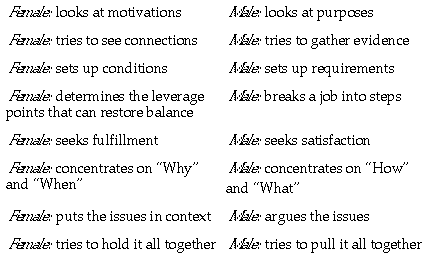
As we can see, though both men and women will use both techniques depending on context, one kind comes first or takes priority. Which one is the principal technique is determined by mental sex. So, if you keep in mind that this all may be overshadowed by other learned techniques, you can illustrate male and female problem solving techniques as a TENDENCY to employ those listed above, all other things being equal.
From the Dramatica Theory Book